



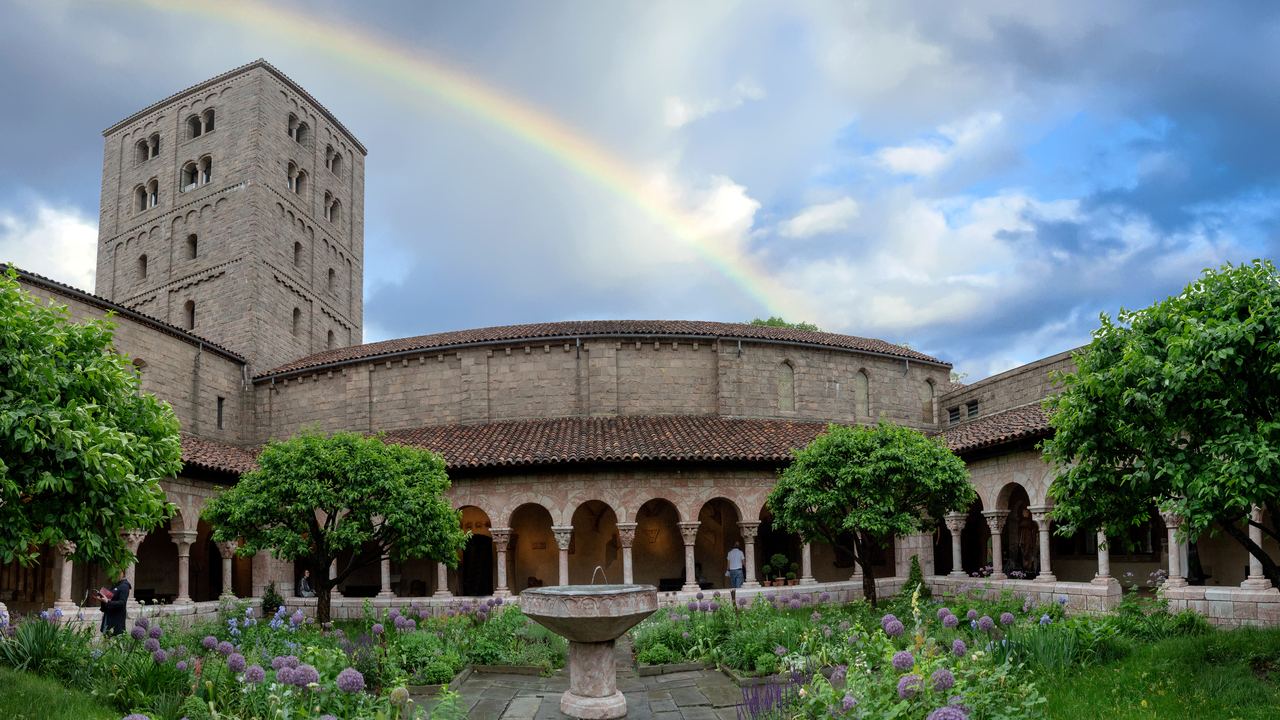
The Met Cloisters is the Metropolitan Museum's second building: a museum of medieval European art on a hilltop in Fort Tryon Park, at the northern end of Manhattan, more than a hundred streets north of the main museum on Fifth Avenue. To get there, take the A train to 190 St and walk about ten minutes through the park, or ride the M4 bus to its last stop. It is closed on Wednesdays and open the other six days, 10 am to 5 pm from March through October and only until 4:30 pm from November through February (hours checked in September 2026). There is no separate ticket: a Met ticket covers both buildings on the same day, and advance booking isn't required.
Inside are about 2,000 works, most of them from the 12th to the 15th century, in a building assembled in the 1930s around pieces of real French and Spanish monasteries, including the room where the seven Unicorn Tapestries hang.
What exactly are the Met Cloisters?
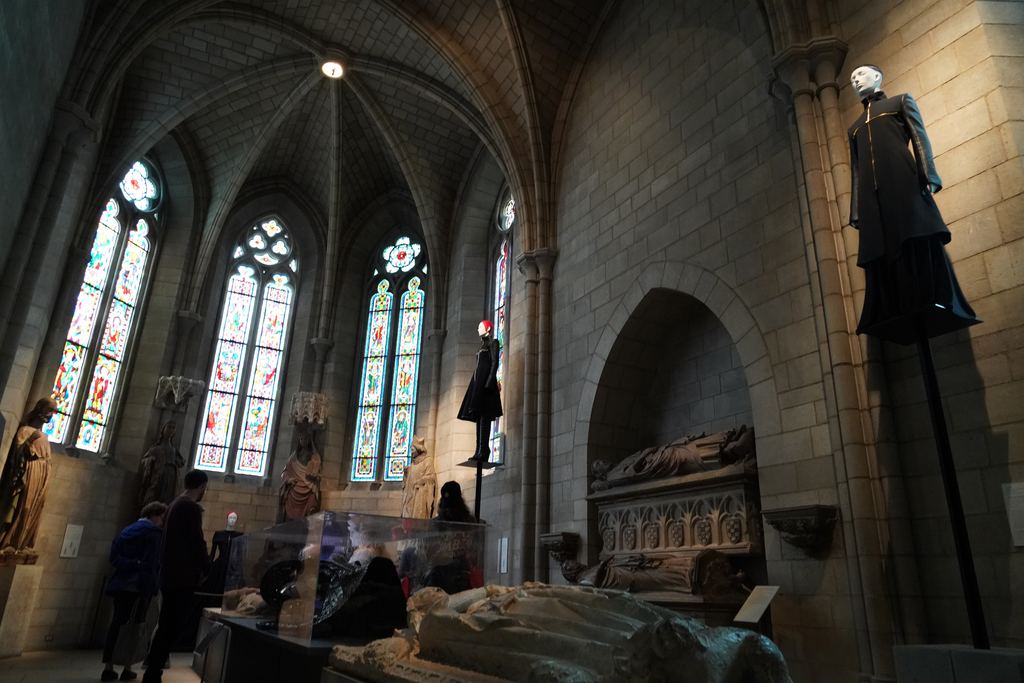
A cloister is the square of covered walkways around an open courtyard at the center of a monastery. The museum takes its name from portions of five medieval cloisters, taken apart in France, shipped to New York and rebuilt here with new masonry around the original columns and capitals. According to the Met's own history page, the building copies no specific medieval structure: the architect Charles Collens and the curators Joseph Breck and James Rorimer designed it as a run of rooms sized to fit the pieces they had. So the walls are often the exhibit. Doorways, windows, a chapter house and a whole church apse are built in, and the tapestries, ivories and manuscripts sit in rooms made around them. The Met calls it America's only museum dedicated exclusively to the art and architecture of the Middle Ages, which is its own claim; we haven't found a reason to doubt it.
Are the Cloisters worth the trip, and who should skip them?
If you like old stone, yes. It is a different visit from Fifth Avenue, not a smaller version of it. Fifth Avenue is galleries you walk through; the Cloisters is rooms and courtyards you can sit in. The Cuxa garden has benches, the Bonnefont Cloister looks across the Hudson to the Palisades, and the building is small enough to see without a plan.
It is also much quieter. In its record year, fiscal 2019, the Cloisters counted 325,326 visitors (Met press release, July 2019), a peak the museum credits to the Heavenly Bodies exhibition. Across its three buildings the Met counted "more than 7 million" visitors that year, so fewer than one in twenty went uptown. No Cloisters-only figure has been published since.
Who should probably skip it:
- First-time visitors with one or two days in New York who haven't seen Fifth Avenue. The main building has medieval galleries of its own.
- Anyone who came for paintings. Apart from the Merode Altarpiece and some altarpiece panels, this is stone, glass, tapestry, ivory and books.
- Visitors who need step-free access and can't plan ahead: the museum counts roughly 60 steps from the front door to the ticket desk, and the step-free alternative depends on a shuttle.
Plan around Wednesday: both Met buildings are closed that day. And from November to February the Cloisters closes at 4:30 pm, half an hour before Fifth Avenue.
How did a medieval museum end up in Upper Manhattan?
Through two men and a landscape firm. George Grey Barnard, a sculptor who had studied with Rodin, collected medieval fragments and showed them on Fort Washington Avenue. John D. Rockefeller Jr. paid for the Met to buy that collection, bought the hilltop to the north, had the Olmsted Brothers make it a park, and gave the park to the city while keeping four acres for a new museum. Dates come from the Met's history page, the city's 1974 landmark report and NYC Parks.
The Cloisters, from Barnard's gallery to today
The origins
1914
Barnard's Cloisters opens
Barnard opens his collection to the public at 698 Fort Washington Avenue.
1917
Rockefeller buys the hilltop
He buys the Billings estate and hires the Olmsted Brothers; Frederick Law Olmsted Jr. spends four years reshaping the rocky site.
1925
The Met buys Barnard's collection
Rockefeller pays for it. It reopens in 1926, in the same building, as a branch of the Met.
1930-31
The land goes to the city
Rockefeller keeps four acres for a museum. NYC Parks dates the gift 1931; the landmark report says 1930.
1933
About 700 acres of the Palisades
He gives land on top of the cliffs across the Hudson. Why exactly is disputed (see below).
The growth
1935
Fort Tryon Park opens
The park and its Heather Garden open. Work on the museum, begun in 1934, goes on.
May 10, 1938
The Cloisters opens
Charles Collens's building, with granite outer walls from New London, Connecticut, and limestone from near Genoa inside.
1957-61
An apse from Spain
Spain lends the 12th-century apse of a church at Fuentidueña, over 3,000 blocks, rebuilt here in 1958-61.
1963
The Cloisters Cross
The museum acquires the 12th-century walrus-ivory cross now in the Treasury.
1974
A city landmark
Designated March 19, 1974. Fort Tryon Park follows in 1983.
Today
2025
Still collecting
A 1462 astrolabe by Regiomontanus joins the collection and goes on view in gallery 016.
About the Palisades, since the short version is everywhere. The Met says Rockefeller gave the land to preserve the view from The Met Cloisters. The Palisades Interstate Park Commission calls that an oft-repeated anecdote and quotes his 1933 letter: his "primary purpose" was to protect the land along the top of the cliffs, as part of a wider conservation and parkway plan. Both can be true, and the cliffs you see from the Bonnefont Cloister are parkland either way.
What are the five cloisters, and which rooms should you see?
The Met names them Saint-Michel-de-Cuxa, Saint-Guilhem-le-Désert, Trie-sur-Baïse, Froville, and elements associated with Bonnefont-en-Comminges. Its history page now says those last pieces were "once thought to have come from" Bonnefont, so read the name as a label. None came over whole, and Saint-Guilhem is the only one under a roof.
You enter on the upper level, which the museum calls the first floor. The Bonnefont and Trie cloisters, the Gothic Chapel and the Treasury are one level down, on the ground floor. The numbers are the Met's gallery numbers.
| Space (gallery) | Floor | Origin | Look for |
|---|---|---|---|
| Cuxa Cloister (007) | First | Saint-Michel-de-Cuxa, near the Pyrenees, ca. 1130-40 | Pink marble capitals, a garden with benches |
| Saint-Guilhem Cloister (003) | First | Saint-Guilhem-le-Désert, near Montpellier | 140-plus carved fragments under a skylight |
| Froville arcade (021) | First | 15th-century priory of Froville, Lorraine | Nine pointed arches by the upper entrance |
| Fuentidueña Chapel (002) | First | 12th-century church apse, Fuentidueña, Spain | Catalan fresco, painted crucifix, Biduinus's portal |
| Romanesque Hall (001) | First | French doorways, Spanish frescoes | The Moutiers-Saint-Jean doorway; a lion and a dragon |
| Pontaut Chapter House (006) | First | Notre-Dame-de-Pontaut, founded 1115 | The stone bench where the monks met daily |
| Unicorn Tapestries Room (017) | First | South Netherlands, 1495-1505 | The seven Unicorn Tapestries |
| Nine Heroes Room (018) | First | Tapestries of ca. 1400-1410 | King Arthur |
| Merode Room (019) | First | Southern Netherlands, ca. 1427-32 | The Merode Altarpiece |
| Boppard Room (016) | First | Carmelite church at Boppard, 1440-46 | Six stained-glass windows; the astrolabe |
| Late Gothic Hall (020) | First | German, Spanish, Italian altarpieces | Two Riemenschneider sculptures |
| Bonnefont Cloister (011) | Ground | Late 13th-14th century | 19 raised beds, the Hudson view |
| Trie Cloister (012) | Ground | Carmelite convent, Trie-en-Bigorre | Fountain in a meadow garden |
| Gothic Chapel (009) | Ground | A modern room, built in 1938 | Tombs of the counts of Urgell; a knight's effigy |
| Treasury (013, 014) | Ground | Manuscripts, ivories, metalwork | The Cloisters Cross, the Belles Heures |
Which works should you not miss at the Cloisters?
We checked where each of these is shown in the Met's collection database on September 29, 2026. Objects move, so look up anything you care about the week you go.
The Unicorn Tapestries, gallery 017
Seven tapestries tell the hunt of a unicorn, from The Hunters Enter the Woods to the best known, The Unicorn Rests in a Garden, where the animal sits chained inside a fence. The Met dates them 1495-1505, designed in France and woven in the South Netherlands. They were first recorded in Paris in 1680, and Rockefeller gave them to the museum in 1937 (the seventh survives as two fragments, given in 1938). Take your time: the plants in the backgrounds can be identified, and many of them grow one floor down in the Trie Cloister.
The Merode Altarpiece, gallery 019
The Annunciation Triptych, known as the Merode Altarpiece, is a small oil on oak of about 1427-32 that puts the Annunciation in a Flemish living room, with Joseph making mousetraps in the right wing. The Met now catalogs it as workshop of Robert Campin, so guidebooks that call it simply Campin's are a step behind. On the museum's map the room is the Merode Room.
The Cloisters Cross, gallery 014
A walrus-ivory cross of about 1150-60, covered in small carved figures and inscriptions. The Met calls it British and "attributed by some" to the abbey of Bury St Edmunds. Keep the hedge: the origin is argued over. It is in the Treasury on the ground floor.
The Belles Heures and the Hours of Jeanne d'Evreux, gallery 013
Two famous prayer books share the Treasury: the Belles Heures of Jean de France, duc de Berry, painted by the Limbourg brothers in 1405-1408/09, and the tiny Hours of Jeanne d'Evreux by Jean Pucelle, about 1324-28. A book shows one spread at a time, and manuscripts are usually rotated off display to rest them from light. Both were listed on view in gallery 013 on September 29, 2026; that can change month to month. Also look for the Cloisters Playing Cards, and the enamelled Beaker with Apes in gallery 014. The museum's free audio guide, on its website, has a Cloisters highlights playlist: bring headphones.

Gardens and the view
When are the Cloisters gardens worth seeing?
Three cloisters are gardens, planted from medieval treatises, poems, herbals and works of art. The Bonnefont garden grows between 250 and 300 species in raised beds grouped by use (the Met has given figures from "more than 250" to "approximately 300" over the years). The Trie garden copies the flowering meadows of medieval art, with many plants from the Unicorn Tapestries. The Cuxa garden mixes medieval species with modern ones.
The museum's guidance is general: many plants peak in late spring and early summer, Cuxa has color from early spring to late fall, and in winter the Cuxa arcades are glazed and filled with potted plants and forced bulbs. We don't publish a bloom calendar because the museum doesn't. Whatever the season, the Bonnefont Cloister looks west over the Hudson to the wooded cliffs of the Palisades.
What are the Cloisters' opening hours, and is it the same ticket as the Met?
As of September 2026, the museum lists:
- March 1 to October 31: Thursday to Tuesday, 10 am to 5 pm.
- November 1 to the end of February: Thursday to Tuesday, 10 am to 4:30 pm.
- Closed: Wednesdays, Thanksgiving Day, December 25 and January 1.
One difference catches people out. Fifth Avenue closes on the first Monday in May for the Met Gala; the Cloisters' hours list no such closure, so that day it is the Met building you can visit. Fifth Avenue also stays open to 9 pm on Fridays and Saturdays. The Cloisters has no late night.
Tickets are shared: "All tickets include exhibitions and same-day entry to both Met locations for the date printed on your ticket." Most visitors pay the full adult price; pay-what-you-wish is open only to New York State residents and to students in the tri-state area (New York, New Jersey, Connecticut), and children 12 and under go free (details on our admission page). None of the tour operators we list sells a Cloisters visit, and outside guides must register with the museum, so for most people the audio guide is the guide.
Buy one ticket and use it twice: a Met ticket is valid at Fifth Avenue and at the Cloisters, but only on the date printed on it.
How do you get to the Cloisters?
The address is 99 Margaret Corbin Drive, inside Fort Tryon Park. Train and bus times below are our daytime medians from the MTA's published timetables for fall 2026; they leave out waiting and traffic.
| Route | How | Time | Worth knowing |
|---|---|---|---|
| A train and walk | A to 190 St, exit by elevator, walk north on Margaret Corbin Drive | About 20 min from 59 St-Columbus Circle (22 at weekends) plus a 10-min walk | Fastest from Midtown; weekend track work can affect the A |
| A train and M4 | Same train, then the M4 north one stop | Train, then one stop | Saves the uphill walk |
| Step-free | A to 181 St, elevator, M4 north 7 stops | About 18 min of train from 59 St, then the bus | The museum's accessible route; 190 St is not rated ADA-accessible |
| M4 from the Met | Madison Av/83 St to the last stop, Margaret Corbin Dr/Cloisters | 82 min weekdays, 71 Saturdays, 64 Sundays (museum: about 1 h 25) | Board a bus signed Cloisters |
| Back by subway | A to 125 St, B or C to 81 St, M79 crosstown | About 21 min of train plus changes | The museum's return route |
| Car | Henry Hudson Parkway north, first exit after the George Washington Bridge | Depends on traffic | Free parking in the park; exit on the northbound side only |
Two things save time. Not every northbound M4 goes to the Cloisters: some are signed for Cabrini Boulevard, so read the sign. And the 1 train, which also runs up here, stops at 191 St, about 1.1 km from the museum in a straight line against 700 m from the A's 190 St; the museum doesn't send visitors that way. Routes to Fifth Avenue itself are on our getting-there page.
Is the Cloisters accessible for wheelchair users?
Partly, with planning. The museum says access is "somewhat limited" because of the building's landmark status: cobblestones on the approach and about 60 stairs from the main (Postern) entrance to the admissions desk. Its Cloisters accessibility guide lists the alternatives:
- A free shuttle to a step-free entrance, picked up near the main entrance.
- Car drop-off at the step-free courtyard entrance (clearance 10 ft 6 in high, 9 ft wide) and two spaces for disabled permit holders.
- An elevator: ask a security officer.
- Free wheelchairs, first come, first served, and stools, at the desk in the Main Hall.
Use the A to 181 St and the M4, not 190 St. Questions: [email protected] or 212-731-1127 during opening hours. Strollers face the same limits. More on our accessibility page.
Can you do the Met Fifth Avenue and the Cloisters in one day?
Yes, and the same-day ticket allows it, but it is a long day: about an hour between the two buildings by subway, closer to an hour and a half on the M4. It suits people who have already seen Fifth Avenue, or who have three or more days in New York and want medieval art. It doesn't suit a first visit with children, or anyone who wants a proper look at Fifth Avenue's big collections.
A sequence that works, Cloisters first:
- About 9:30, A train from Midtown to 190 St, then the walk up. In at 10 am.
- 10:00 to 12:30 at the Cloisters: enough for the main rooms and the gardens.
- Lunch at the seasonal café in the Trie Cloister or on the way. Outside food isn't allowed inside (water in a closed bottle is).
- Back down: the M4 if you'd rather sit than change, the subway and the M79 if you want speed.
- Fifth Avenue from about 2:30 until 5 pm, or until 9 pm on a Friday or Saturday.
Why this order: the Cloisters closes first, and its gardens want daylight. Done the other way round, leave Fifth Avenue by 2 pm in winter to get a useful stretch uptown before the 4:30 pm closing. Never on a Wednesday, and not on Met Gala Monday, when Fifth Avenue is shut. Longer plans are in our itineraries around the museum.
What is there to do near the Cloisters?
The museum sits in Fort Tryon Park, 67 acres according to NYC Parks, designed by Frederick Law Olmsted Jr., son of the co-designer of Central Park. Its Heather Garden, open since 1935, is in the city's words its largest garden with unrestricted public access: a 600-foot promenade with more than 500 kinds of plants, free, at the park's southern end near the 190 St station. Paths on the western edge look across the Hudson to the Palisades, and the drive up is named for Margaret Corbin, who took over her fallen husband's cannon when the British attacked this hill in 1776. In good weather the walk is part of the visit; in rain, take the M4 the last stop.

Met Cloisters: quick answers
Are the Met Cloisters worth visiting?
Yes, for medieval art, architecture and gardens, or once you've seen Fifth Avenue. Skip it on a short first trip, or if you came for paintings.
How long do you need at the Cloisters?
Two to two and a half hours inside, longer if you linger in the gardens, plus the ride: about 20 minutes on the A train from 59 St and a 10-minute walk each way. Treat it as half a day.
Is the Cloisters ticket the same as the Met ticket?
Yes: one ticket covers both buildings on the date printed on it. Advance booking isn't required. Prices are on our admission page.
How do I get to the Cloisters?
A train to 190 St, then 10 minutes on foot or a short ride on the M4. Step-free: A to 181 St and the M4 seven stops. From Fifth Avenue the M4 goes all the way.
Can I see Fifth Avenue and the Cloisters in one day?
With the same ticket, yes. Start at the Cloisters at 10 am, leave around 12:30, and spend the afternoon at Fifth Avenue, best on a Friday or Saturday when it is open until 9 pm.
Is the Cloisters open on Wednesday?
No, neither Met building opens on Wednesdays.
Is the Cloisters open on Met Gala Monday?
Its hours as listed in September 2026 show no closure that day, while Fifth Avenue closes. Check the museum's Cloisters visit page before going.
Is the Cloisters wheelchair accessible?
Partly. About 60 stairs lead from the main entrance, but a free shuttle goes to a step-free entrance, and there is an elevator. See our accessibility page.
Are there guided tours of the Cloisters?
No operator we list sells one. The museum's free audio guide has a Cloisters highlights playlist.
Planning the Fifth Avenue half of the day?
Hours, admission, bag rules and routes inside the main building are in our visit guide.
Data verified on. Hours, galleries and access from the Met's CMS and collection database; history from the Met, NYC LPC and NYC Parks; times from MTA timetables. Editorial Policy