



Most of what gets repeated about the Metropolitan Museum in New York is half true or out of date. The big ones: the museum is not free for tourists, a ticket is good for one day, not three, you don't need to book ahead, and the building is closed on Wednesdays, not Mondays. No city pass gets you in, it isn't the biggest museum on the planet, and neither The Thomas Crown Affair nor Night at the Museum was shot in its galleries.
We checked each claim against the museum's own texts (its policies, press releases and collection records, read on September 29, 2026) and, where the museum is silent, against the best outside source we could find. The second half of the page is the fun part: about twenty things in and around the building that sound made up and aren't, each with the place where you can go and look at it.
Which Met myths does the web still repeat?
Most of these started as facts. Rules at the Met have changed several times since 2013, and old forum answers still rank next to new ones. The table gives the verdict; the notes under it give the evidence and the date.
| What people say | Verdict | What the evidence says | Source and date |
|---|---|---|---|
| The Met is free | False for most visitors | Only New York State residents and students from NY, NJ and CT may pay what they wish; everyone else pays the full price | Plan Your Visit, updated Sept 24, 2026 |
| A ticket is valid for three days | False since 2020 | Same-day entry to both Met sites, for the date printed on the ticket | Plan Your Visit, 2026; press release Jan 4, 2018 |
| You must book in advance | False for individuals | Advance tickets are not required; groups and third-party guided tours must register | Plan Your Visit, 2026; Group Guidelines, Aug 14, 2025 |
| It's closed on Mondays | Out of date | Monday closing ended July 1, 2013; Fifth Avenue now closes on Wednesdays | Press releases 2013 and Nov 25, 2025 |
| CityPASS or a reseller voucher gets you in | False | The museum accepts no vouchers or passes from outside ticket sellers | Complimentary admission policy, June 5, 2026 |
| It's the largest museum in the world | Not by floor area | About 2 million sq ft at Fifth Avenue against the Louvre's 244,000 m2 of flooring | Met texts 2008-2019; Louvre press office, July 2026 |
| The Thomas Crown Affair was filmed inside | False | The request to film was reportedly declined; the finale was shot at the New York Public Library | Artnet News, Feb 19, 2024 |
| Night at the Museum is set at the Met | False | The films are set at the American Museum of Natural History | AMNH website |
| Egypt gave the Temple of Dendur to the Met | Partly | Egypt gave it to the United States in 1965; it was awarded to the Met in 1967 | Collection credit line; Met essay, updated 2026 |
| The Cloisters is a monastery shipped from Europe | Partly | A 1938 building that incorporates parts of several medieval cloisters | History of The Met, updated Feb 9, 2026 |
| The Met Breuer, the Sackler Wing and the roof bar | Gone or renamed | Breuer closed in 2020, the Sackler name was removed in 2021, the roof garden is shut, with a reopening the museum has announced for 2030 | Met history page and releases |
Is the Metropolitan Museum free?
It was, until 1971. A 2013 amendment to the museum's lease with the City says the Parks Department "fully authorized the Museum to begin charging visitor fees in 1971" (Met press release, October 24, 2013). For decades the fee was a recommended amount, which is where the "it's really free" advice comes from. That ended on March 1, 2018, when a new policy made the fee mandatory for visitors from outside New York State.
Today the museum's Plan Your Visit page (updated September 24, 2026) keeps pay-what-you-wish for residents of New York State and for students from New York, New Jersey and Connecticut, and even they have to pay at least one cent. Everyone else pays the full price. Children 12 and under go in free. Who else qualifies is on our admission page.
Is a Met ticket valid for three days?
No, and this is the myth with the longest tail. For decades a ticket was good for one day at the main building and the Cloisters. The rule then changed four times in seven years. From May 1, 2013, a ticket from the main building added one visit to the Cloisters within the following seven days; it did not work the other way round. From March 2016, with the opening of the Met Breuer, a ticket was good at all three buildings on the day of the visit. From March 1, 2018, full-price tickets were honored for "three consecutive days at The Met's three locations" (press release, January 4, 2018). And from September 12, 2020 it has been the same day at both remaining sites, a change that got one sentence in the timed-ticket announcement of August 25, 2020 and no release of its own.
"All tickets include exhibitions and same-day entry to both Met locations for the date printed on your ticket." (Plan Your Visit, September 2026)
So one ticket covers Fifth Avenue and the Cloisters on the same date, special exhibitions included, and you can leave and come back that day. The next morning you pay again.
Do you have to book Met tickets in advance?
Not as an individual visitor. The museum's wording is plain: "Tickets can be purchased online, but advance tickets are not required." The timed-entry system that many blog posts still describe was a pandemic measure from the August 29, 2020 reopening and no longer exists. Booking online saves you the ticket desk; it does not save you the security check, which everyone passes. Groups are different: the Group Guidelines (August 14, 2025) require "advance reservations" for all adult and student groups "and for any third-party guided tours, regardless of size".
Is the Met closed on Mondays?
It used to be. Both buildings "have traditionally been closed on Mondays", and from July 1, 2013 they opened seven days a week (press release, 2013). After the 2020 reopening the days changed again, and the pattern in September 2026 was Thursday through Tuesday, closed Wednesdays, with Fifth Avenue open to 9 p.m. on Fridays and Saturdays (press release, November 25, 2025). If a guide tells you Monday or Tuesday, it was written for a museum that no longer keeps those hours. The museum's Plan Your Visit page has the current hours, and our hours page covers holidays and timing.
Does a New York City pass include the Met?
The Met does not accept vouchers or passes from any outside ticket sellers.
That sentence from the museum's admission policy settles most pass questions. The big city passes we checked on September 29, 2026 list other museums (CityPASS names the Guggenheim and the Whitney) but not the Met. What passes do and don't cover nearby is on our passes page.
Is the Met the largest museum in the world?
The museum itself can't decide. A 2019 release on gift policies calls it "the largest art museum in the world in both physical and financial terms", a 2015 museum blog post calls it "the second-largest museum in the world", and press boilerplate from 2008 settles for "the largest museum in the Western Hemisphere". The numbers don't back the first claim. Fifth Avenue has "over two million square feet", about 186,000 square meters; the Louvre press office gives "244,000 m² of flooring" (page dated July 2026). The safe statement is that the Met is the largest art museum in the United States.
Was The Thomas Crown Affair or Night at the Museum filmed at the Met?
Neither. In the 1999 Thomas Crown Affair the stolen Monet belongs to the Metropolitan Museum by name, but according to Artnet News (February 19, 2024) the request to film there was reportedly "respectfully declined"; some museum scenes were shot on a soundstage and the finale at the New York Public Library, two miles south. The same article notes the Met doesn't own a version of San Giorgio Maggiore at Dusk, the painting at the center of the plot.
Night at the Museum is set at the American Museum of Natural History, on the other side of Central Park. The film that did get inside is Ocean's 8 (2018): director Gary Ross told Slate that "all the stuff in the Temple of Dendur is practical at the Met", while the costume exhibition where the heist happens was a set on a soundstage in Bethpage, Long Island.
Did Egypt give the Temple of Dendur to the Met?
Not directly. The credit line reads "Given to the United States by Egypt in 1965 and awarded to The Metropolitan Museum of Art in 1967." The award came in a letter President Lyndon B. Johnson signed on April 28, 1967 (Met essay, updated March 12, 2026). The Smithsonian wanted the temple for Washington. The story that Jacqueline Kennedy lobbied for Washington too comes from a single source, former director Thomas Hoving's 1993 memoir, as reported by Artsy; the Met's own texts don't mention her.
Two more that fall in the same bin: the Cloisters is a 1938 building, and the museum's history page says it "is not a copy of any specific medieval structure"; and the Met Breuer closed in summer 2020, when the Met handed its lease to the Frick. The "Sackler Wing" name for the Dendur gallery was dropped on December 9, 2021, and the Cantor Roof Garden has been closed since October 2025; the museum has announced its reopening for 2030. The longer story is on our history page.
What curiosities can you see on the building itself?
Stand across Fifth Avenue and look above the paired columns by the entrance. The four big blocks of stone were never carved. Richard Morris Hunt wanted four sculptors to turn them into groups for the "four great periods of Art" (Egyptian, Greek, Renaissance and modern). When the plan was dropped, the stone stayed, because "its bulk and weight were deemed necessary to balance the façade" (Met press release, March 6, 2006).
Don't confuse them with the four niches lower down. Those stayed empty for 112 years, until the museum started its Facade Commission for contemporary artists in 2019, according to a museum article of 2025. Hunt, a trustee, also designed the base of the Statue of Liberty; he died in 1895, and his son finished the building, which opened in December 1902 (Great Hall release, 2010).

The first museum is still inside. Calvert Vaux and Jacob Wrey Mould's Gothic building of 1880 left its west facade visible within the Robert Lehman Wing, and 140-year-old beams in the ceiling of the Medieval Sculpture Hall (Today in Met History: March 20). A correction to many guides: the classical wall at the back of the Petrie European Sculpture Court is not Vaux and Mould. It is Theodore Weston's south facade of 1888 (The Museum, Constructed, 2010).
The ground under all of it is Central Park. The museum has stood on "its current site in Central Park along Fifth Avenue (from 80th to 84th Street) since 1880", in a City-owned building it holds under an 1878 lease (2013 lease release). Just behind the museum, and visible from several of its windows, stands Cleopatra's Needle, which has nothing to do with Cleopatra. It is an obelisk of Thutmose III made around 1425 BCE in Heliopolis, dedicated in the park in 1881 (Central Park Conservancy), and it isn't a Met object. The museum calls it "the only monumental obelisk from ancient Egypt in the United States" (exhibition release, 2013).

Which objects in the collection have the strangest stories?
The first thing the Met ever acquired has accession number 70.1: 1870, object one. It is a Roman "marble sarcophagus with garlands" of about 200 to 225 CE, a gift of Abdo Debbas, acquired on November 20, 1870 (collection record 239584; History of The Met). The collection API lists it in Gallery 169.
The oldest-dated objects in the online collection are not Egyptian. They are nine Acheulean hand axes dated 700,000 to 200,000 BCE, catalogued in Arms and Armor and shown in Gallery 370 (collection API, accessions 2018.51.1 to .9). That is the answer for catalogued online records only; we can't vouch for objects that aren't online.
William, the blue faience hippo the museum treats as its mascot, got his name from a 1931 story in the British humor magazine Punch. The Met adds a darker detail: "three of the sculpture's legs were probably broken on purpose in antiquity, rendering the animal immobile" (press release, September 28, 2017). He is in Gallery 111, accession 17.9.1.
Washington Crossing the Delaware was painted in Germany: the signature reads "E. Leutze / Dusseldorf 1851". The museum's own audio stop admits the errors: "the boats are crossing the river in the wrong direction; the ice flows are impossibly large; and there were no horses or artillery in the boats" (object page, Wayback capture of December 2025). The gilded frame is a reproduction, rebuilt from an 1864 photograph for the 2012 reopening of the American Wing. The canvas is 149 by 255 inches.
Other one-liners the museum publishes about itself: its longest work is a 16th-century Egyptian carpet; the Ronald S. Lauder Arms and Armor Court holds "one of Henry's personal armors, made in Italy and worn by the king in his last campaign against the French at Calais in 1544" (that is the field armor of about 1544, not the garniture of 1527 in the same court, which the museum calls only "probably" Henry VIII's); and in 1910 the Met became "the first public institution in the world to acquire a work of art by Henri Matisse".
Which records and odd episodes belong to the Met's history?
The Mona Lisa came to the Met. She went on view on February 7, 1963 and drew "more than one million visitors to The Met in the span of a single month" before the show closed on March 4 (Met article on the 1963 newsreel).
The most visited exhibition in the museum's history was a fashion show. Heavenly Bodies: Fashion and the Catholic Imagination counted 1,659,647 visitors between May 10 and October 8, 2018, at Fifth Avenue and the Cloisters, beating Treasures of Tutankhamun (1978, 1,360,957) (press release, October 11, 2018).
The Met Gala began in 1948 as "a midnight supper that invited guests could attend for fifty dollars a ticket", the idea of publicist Eleanor Lambert (Met article, 2020). Today it closes the museum to visitors on the first Monday in May. The Costume Institute's own collection, more than 33,000 costumes and accessories by the museum's current count, is never on permanent view, because textiles can't take the light.
The copyist program, which lets artists paint copies in the galleries, is "the longest-running program at the Museum, originating in 1872", eight years before the museum moved to the park (The Copyist’s Copy, 2016). The Astor Court, the Ming-style garden court in Gallery 217 that opened in 1981, was built in New York by twenty-six Chinese craftsmen who came "along with a chef" and spent six months assembling it; an 18th-century imperial kiln was reopened to fire its tiles (the museum's gallery description, updated January 2026).
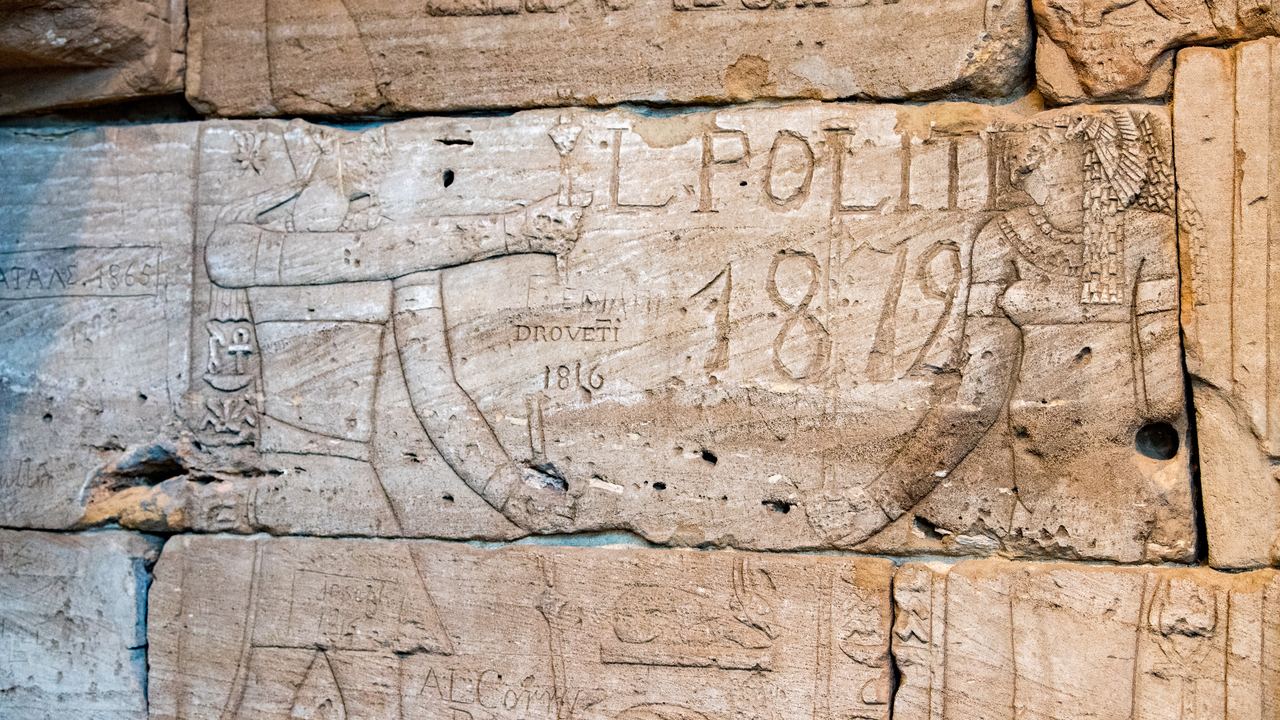
The Temple of Dendur's crates arrived on August 20, 1968 and sat in an inflated shelter on the museum's south parking lot, where the Petrie Court now is (Met essay). The temple opened to the public on September 27, 1978, facing east toward a wall of windows. Look for carved names on its stones: travelers scratched them there, and one Leonardo left his about two centuries ago, as the museum's MetKids text puts it. The pharaoh on the walls is the Roman emperor Augustus.
Where can you find each curiosity?
Gallery numbers come from the museum's collection records and gallery descriptions as of September 2026. Galleries close for works at short notice, so check the museum's map on the day. Our routes page fits several of these into a two-hour visit.
| Curiosity | Where | Source |
|---|---|---|
| Uncarved blocks and the Facade Commission niches | Fifth Avenue facade, outside | Met release 2006; Met essay 2025 |
| The 1880 Vaux and Mould facade | Robert Lehman Wing | History of The Met |
| Weston's 1888 facade | Petrie European Sculpture Court, Gallery 548 | The Museum, Constructed, 2010 |
| 1880 ceiling beams | Medieval Sculpture Hall, Gallery 305 | Today in Met History: March 20 |
| Object 70.1, the first acquisition | Gallery 169, Greek and Roman Art | Collection record 239584 |
| Stone Age hand axes | Gallery 370, Arms and Armor | Collection API |
| Henry VIII's field armor, about 1544 (the 1527 garniture nearby is only "probably" his) | Gallery 371, Arms and Armor Court | Gallery description, 2026 |
| William the hippo | Gallery 111, Egyptian Art | Press release 2017 |
| Washington Crossing the Delaware | Gallery 760, The American Wing | Collection record 11417 |
| Wall Street bank facade and the Tiffany loggia | Charles Engelhard Court, Gallery 700 | Gallery description, 2026 |
| Frank Lloyd Wright living room | Gallery 745, The American Wing | Gallery description, 2025 |
| Astor Court | Gallery 217, Asian Art | Gallery description, 2026 |
| Temple of Dendur and its graffiti | Gallery 131, Egyptian Art | Met essay; MetKids 2017 |
| Cleopatra's Needle | Central Park, behind the museum | Central Park Conservancy |
Two more for the American Wing: the Charles Engelhard Court is "anchored by the Neoclassical facade of the Branch Bank of the United States, originally located on Wall Street", and the museum says its Frank Lloyd Wright room is "the only opportunity to experience a Wright-designed domestic space in New York City". At the Cloisters, the twelfth-century Fuentidueña apse, more than three thousand limestone blocks, is not Met property: it has been on loan from the Spanish government since 1957. The Cloisters has its own guide on our Cloisters page.
See the Temple of Dendur and the Egyptian galleries with a guide
Tours in our catalog that name the Egyptian collection. Check each tour's text for what the price includes.
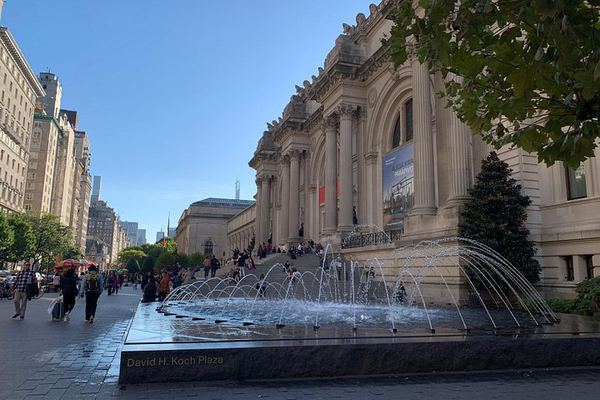
Met Museum Highlights and New York Stories Guided Tour
Egyptian tombs, Roman frescoes, Henry VIII's armor and the Impressionists, tied to New York's own story. 2.5 hours, fees included; the Met shuts Wednesdays.
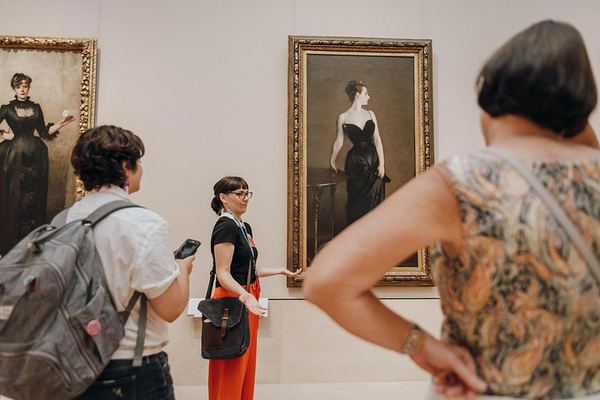
Met Museum Highlights in Two Hours with an Expert Guide
An art guide leads up to 18 people past Monet's Water Lilies, Madame X, Rodin and the Tomb of Perneb in two hours, admission included. You stay on afterwards.
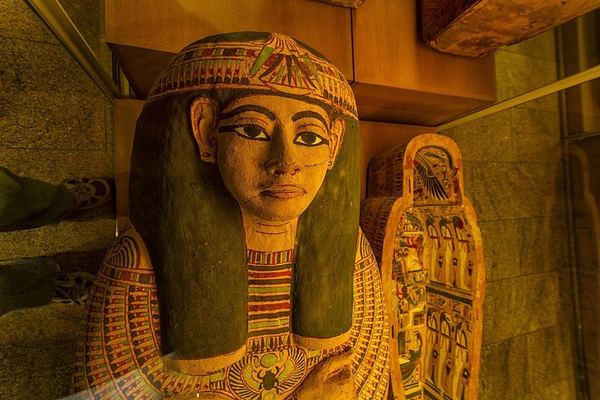
Met Museum Highlights Tour by City Wonders, Entry Ticket Included
City Wonders guides up to 20 people through the Met in two hours, entry ticket included: the Egyptian and American wings, Velazquez, Rembrandt and Van Gogh.
Ratings collected by Viator and Tripadvisor
Quick answers about Met myths
Is the Metropolitan Museum free for tourists?
No. Paying what you wish is an option only for New York State residents and for students in New York, New Jersey and Connecticut. Visitors from elsewhere pay the full price. Children 12 and under are free. Details on our admission page.
Can I use my Met ticket on another day?
No. Since September 12, 2020 a ticket is valid only on the date printed on it, for both Fifth Avenue and the Cloisters, and you can re-enter that day.
What day is the Met closed?
Wednesday. Both sites open Thursday through Tuesday. Fifth Avenue also closes on Thanksgiving, December 25, January 1 and the first Monday in May.
Is the Met bigger than the Louvre?
Not by floor area. The Met's Fifth Avenue building has over two million square feet (about 186,000 m²); the Louvre reports 244,000 m² of flooring. The Met is the largest art museum in the United States.
Can I see the Met Gala outfits any time?
No. The Costume Institute's collection is not on permanent view; you see it only in its exhibitions, which usually open after the Gala in May.
Is Cleopatra's Needle part of the Met?
No. It is a City monument in Central Park, just west of the museum. It is an obelisk of Thutmose III, about 1,400 years older than Cleopatra.
Data verified on. Checked against the Met's CMS, collection API and the outside sources linked in the text. Film claims rely on press reports. Editorial Policy