



The Temple of Dendur and the Egyptian galleries of the Metropolitan Museum
A temple built for Augustus by 10 BC, given by Egypt in 1965 and rebuilt on Fifth Avenue in 1978. Marked closed for three days in September 2026, it was listed as open again on the 29th: check before you book.
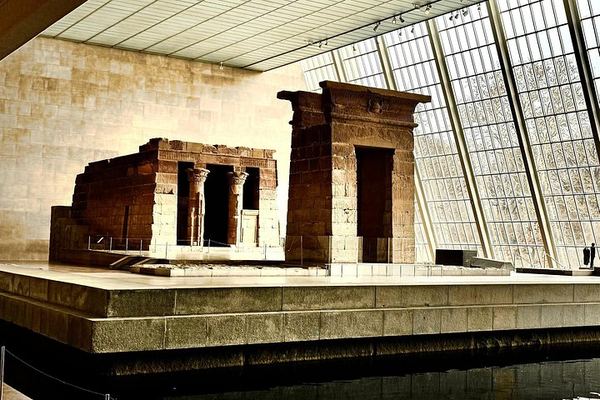
The Temple of Dendur is the one room almost every Metropolitan Museum itinerary names. It was built in Lower Nubia, on the west bank of the Nile about fifty miles south of Aswan, and the museum dates it to 15 to 10 BC, completed by 10 BC under the Roman emperor Augustus, who is carved on its walls dressed as a pharaoh. Since 1978 it has stood in gallery 131 on Fifth Avenue, under a wall made entirely of windows. Across the tour listings on this site it is the stop named more often than any painting or statue, which is why its status this week matters.
Before anything else, one fact with a date on it. The museum's own gallery listing marked the Temple of Dendur as closed on 26 September 2026, and on 29 September it listed the temple as open again. No reason was given for either change. On the same day five other Egyptian galleries, 116 to 120, were flagged closed, while the rest, including the tomb chapel of Perneb and William the hippo's room, are listed as open. Rooms here close and reopen at short notice, so check again before you book a tour for the temple.
This page is about what you are going to look at: the temple, how it crossed the Atlantic, and the rest of a department the museum puts at about 30,000 objects. The tours listed below are general tours of the museum that spend part of their time in these rooms. None of the tours in the catalogue is dedicated to Egyptian art, which is worth knowing before you pay for one expecting two hours of pharaohs. Several start the route in Egypt and then move on. Price is not the obstacle: the median here is €52.78, about what any two-hour group tour of the museum costs. The section near the end says what each one promises.
The temple is part of the permanent collection, so it is covered by an ordinary admission ticket, with no extra charge. What no ticket covers is a gallery that happens to be shut on the day. If the temple is closed when you go, the Egyptian wing is still worth the walk: the tomb chapel of Perneb, the models of Meketre and William were all listed as open on 29 September, along with the Amarna rooms and the galleries of Ptolemaic and Roman Egypt.
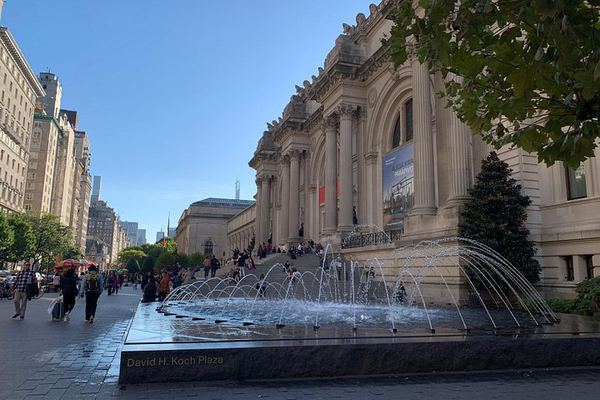
Met Museum Highlights and New York Stories Guided Tour
Egyptian tombs, Roman frescoes, Henry VIII's armor and the Impressionists, tied to New York's own story. 2.5 hours, fees included; the Met shuts Wednesdays.
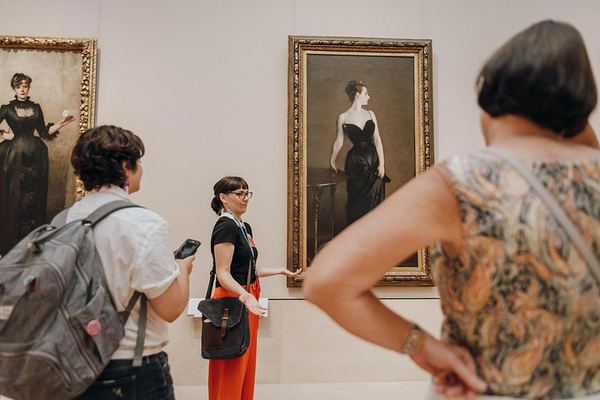
Met Museum Highlights in Two Hours with an Expert Guide
An art guide leads up to 18 people past Monet's Water Lilies, Madame X, Rodin and the Tomb of Perneb in two hours, admission included. You stay on afterwards.
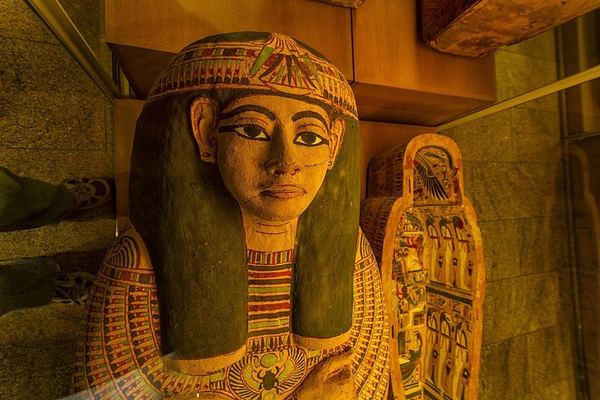
Met Museum Highlights Tour by City Wonders, Entry Ticket Included
City Wonders guides up to 20 people through the Met in two hours, entry ticket included: the Egyptian and American wings, Velazquez, Rembrandt and Van Gogh.

Met Museum Small-Group Tour: Egyptian, European and Asian Art with Admission
Three departments in two hours: Egyptian Art, European Paintings and Asian Art with a live guide, in a group of 12 at most. Museum admission is included.
Metropolitan Museum of Art Guided Tour in Spanish with an Art Historian
Two hours at the Met in Spanish with an official New York guide: Egyptian art, Velázquez, El Greco and the Vélez Blanco patio. Museum entry is included.
Metropolitan Museum of Art: Guided Tour or Orientation with Entry Ticket
Small-group, private or a 30-minute orientation, each with Met entry and same-day access to The Met Cloisters. Private tours come in four languages.
Metropolitan Museum of Art Highlights Guided Tour with Admission
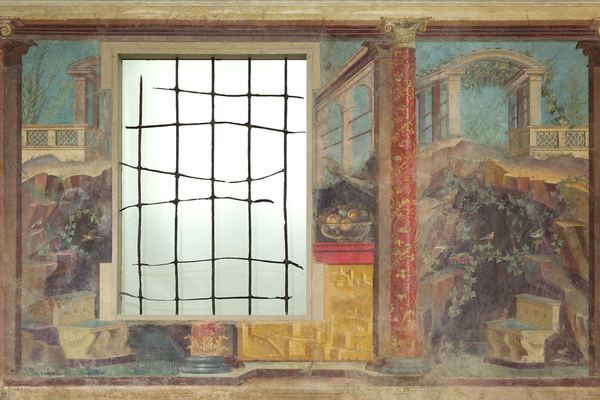
Washington Crossing the Delaware, Vermeer, Van Gogh and a Roman villa bedroom: a two-hour Met highlights route in English, with museum admission included.
The Met Highlights Guided Tour for Small Groups of up to 18
An art historian leads up to 18 people through the Met: Dendur, Henry VIII's armor, Madame X, the Greek and Roman galleries. Admission included, 2 or 3 hours.
The Met Private Tour: Masterpieces with an Art Historian
A private Met tour shaped around your interests by an art historian: Egypt, Vermeer, Sargent's Madame X. Admission included, up to 8 guests, non-refundable.
Ratings collected by Viator, Tripadvisor and Civitatis
What the Temple of Dendur is
It is small. The museum gives the temple itself as about 43 feet long, 21 feet wide and 16 feet high to the roof, built of Nubian sandstone, with a separate gateway in front of it that rises to about 26 feet.
It was built for Augustus, and the museum's essays are precise about whom it honours. It is dedicated primarily to Isis of Philae, with Osiris and Horus, two Nubian gods, Mandulis and Arsenuphis, and two local men, the brothers Pedesi and Pihor. They were believed to have drowned in the Nile and were made gods after their death. Nothing is known about them from any other monument.
Caesar Augustus built this structure by 10 B.C. in Lower Nubia.
Read the walls
Augustus as pharaoh, and the two scenes without him
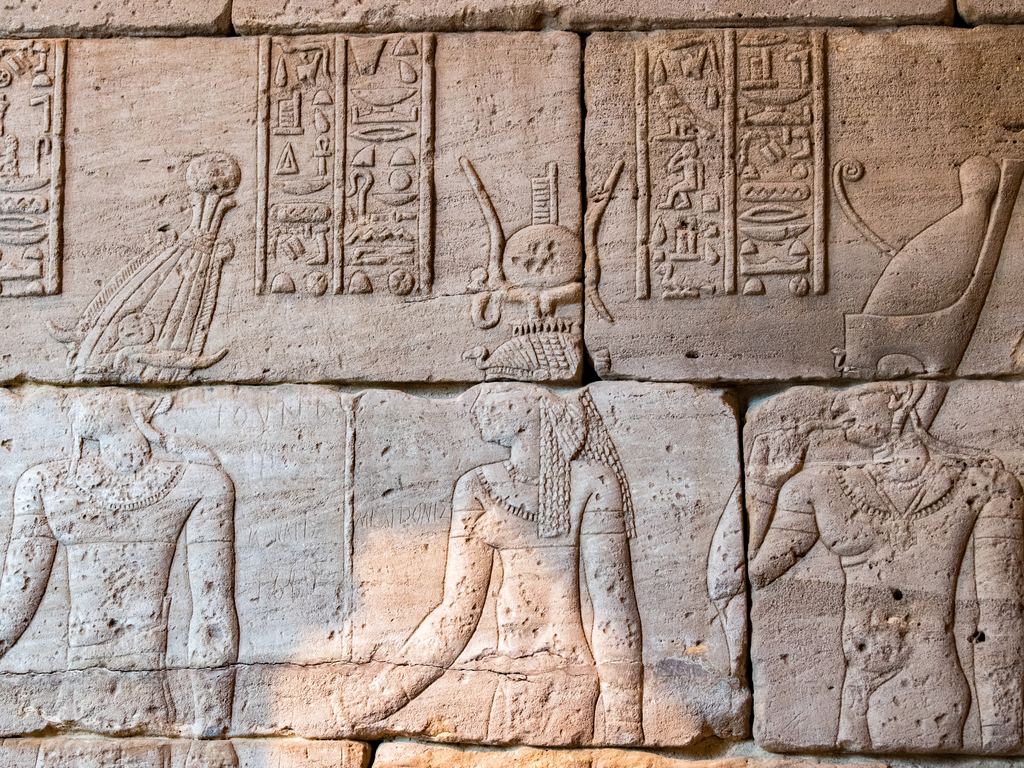
On almost every relief the figure making offerings to the gods is Augustus, shown in Egyptian dress. Some of his cartouches simply say 'pharaoh'; others spell out Greek titles in hieroglyphs, Autokrator and Kaisaros. A Roman emperor, written as a king of Egypt, on a temple in Nubia.
In the sanctuary at the back there are two scenes where he is absent: Pihor worships Isis and Pedesi worships Osiris. According to the museum they are the only scenes in the temple in which Augustus is not the one performing the rite. Behind the sanctuary wall there is also a small secret chamber, reached from outside the temple.
Look at the stone around the doorway too. Visitors have been carving their names into it for about two hundred years, and the museum's own family guide asks children to find the date next to a 'Leonardo' who passed through almost 200 years ago.
How an Egyptian temple ended up on Fifth Avenue
The short version is a dam. Work on the Aswan High Dam began in 1960, and by 1970 Lake Nasser had filled the valley where Dendur stood. UNESCO led an international campaign to move what could be moved, and the museum counts fifty countries that took part and twenty-two temples dismantled and rebuilt on safe ground.
In 1965, to recognise the American contribution to that campaign, Egypt gave the temple and its gateway to the United States. On 28 April 1967 President Lyndon B. Johnson signed the letter that awarded it to the Metropolitan Museum. The blocks crossed the Atlantic in crates on the S.S. Concordia Star and were delivered on 20 August 1968 to an inflatable shelter on what was then the museum's south parking lot.
They waited a decade. The gallery that holds the temple was designed by Kevin Roche John Dinkeloo and Associates, who placed it facing east, as it did on the Nile, under a wall made entirely of windows. It opened to the public on 27 September 1978.
You will read three different dates for the award letter online. The museum's own account says 28 April 1967, and that is the one we use.
The Temple of Dendur, from Nubia to gallery 131
Only dates the museum itself publishes, plus the two changes of 2021 and 2026.
The origins
15–10 BC
Built in Lower Nubia for Augustus
The museum dates construction to 15–10 BC and gives the temple as completed by 10 BC.
1960
Work starts on the Aswan High Dam
By 1970 Lake Nasser covers the stretch of the Nile where Dendur stood.
The growth
1965
Egypt gives the temple to the United States
A gift recognising the American contribution to the UNESCO campaign in Nubia.
28 April 1967
Awarded to the Metropolitan Museum
President Lyndon B. Johnson signs the letter that assigns the temple to the museum.
20 August 1968
The crates reach the museum
Shipped on the S.S. Concordia Star and stored in a temporary shelter on the south parking lot.
27 September 1978
The temple opens in its glass-walled gallery
Rebuilt facing east, as on the Nile, in gallery 131.
Today
9 December 2021
The donor name comes off the wing
The museum removes the Sackler name from its galleries. No official replacement name has been given.
26–29 September 2026
Gallery 131 closed for three days
The museum's gallery listing flags the temple as closed on 26 September, with no reason stated, and lists it as open again on 29 September.
Is the Temple of Dendur open today?
We can only tell you what the museum's own listing said on the day we checked. It marked the temple's gallery as closed on 26 September 2026, and on 29 September 2026 it listed the gallery as open again. The same day it flagged five other Egyptian galleries, 116 to 120, as closed. It gives no reason for any of these changes. A temporary exhibition in the temple's gallery ended on 8 September, so that does not explain the closure.
Short closures of this room are not new. The museum once announced, in a banner on its visitor pages, that the temple would be closed on a Tuesday and a Thursday in the same week in June. The museum states that it does not guarantee access to every gallery at all times.
| Gallery | What is there | Listed as |
|---|---|---|
| 100 | The entrance to the Egyptian galleries and the tomb chapel of Perneb | Open |
| 101 to 112 | Early Egypt, the Old and Middle Kingdoms, the models of Meketre (105) and William the hippo (111) | Open |
| 113 | Life and death in Middle Kingdom Egypt | Open |
| 115 to 120 | Hatshepsut's statues, early Dynasty 18 burials, Amenhotep III and Malqata | 115 open; 116 to 120 closed |
| 121 and 122 | Akhenaten and the Amarna period | Open |
| 123 to 126 | Ramesside and Kushite art, decorated coffins from Thebes | Open |
| 127 to 130 | The Late Period, the last pharaohs, reliefs of Ramesses I | Open |
| 131 | The Temple of Dendur | Open |
| 133 to 138 | Ptolemaic and Roman Egypt, and the special exhibition space (136) | Open |
What to do with this: look at the museum's gallery closures page the day before your visit, and if the temple is the reason you are booking a tour, ask the operator what the route does if gallery 131 is shut on the day. The good ones reroute.

The old name you will still read online
Older guidebooks, other websites and even one of the museum's own articles for families call the temple's home the Sackler Wing. The museum removed the Sackler name from its galleries on 9 December 2021, and it has not announced a new name since. On this site the room is simply gallery 131.
The rest of the Egyptian collection
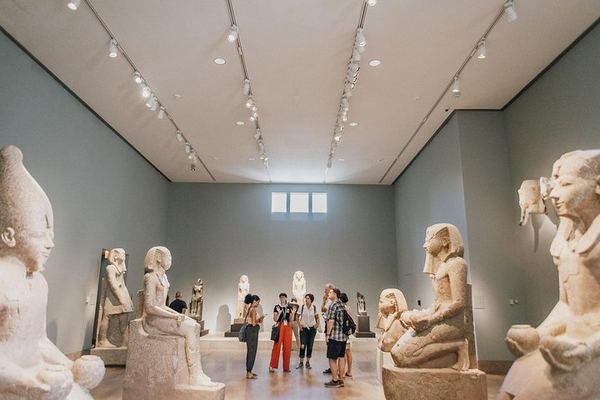
The Department of Egyptian Art was founded in 1906. The museum now puts the collection at approximately 30,000 objects, dating from about 300,000 BCE to the fourth century CE, and says most of it is on view in thirty-eight galleries, the Lila Acheson Wallace Galleries, which opened in 1983. You will see a figure of 26,000 objects on other sites. It is an old number.
Three things are worth finding even on a day the temple is shut:
- The tomb chapel of Perneb, gallery 100, right at the entrance. A real Old Kingdom chapel from Saqqara, dated by the museum to about 2381–2323 BCE, which the museum bought from the Egyptian government in 1913. You can walk into it.
- The models of Meketre, gallery 105: a garden, an offering bearer and six boats made for a tomb around 1981–1975 BCE, each small enough to study up close.
- William, gallery 111. A blue faience hippopotamus about 20 centimetres long, made around 1961–1878 BCE and acquired in 1917. He got his nickname in 1931, and the museum now calls him its informal mascot.
Planning the visit
How long the Egyptian galleries take
Our suggestion, not the museum's: an hour gets you from Perneb at the entrance through the models of Meketre and William's room to the temple, with time to sit by the water in gallery 131 when it is open. Two hours lets you read the rooms in between, and most people run out of attention before they run out of galleries.
A guided highlights tour gives Egypt a fraction of that, usually near the start of the route, before moving on to Greek and Roman sculpture. If Egypt is why you came, see the highlights with a guide and come back to these rooms on your own afterwards. Your ticket is valid all day.
Which tours on this page go to the Egyptian galleries
All nine tours on this page are general tours of the museum. They are here because eight of them name the Temple of Dendur in their descriptions, and the ninth names Egyptian art as one of its three focus areas. What they offer:
- Four group highlights tours, two hours, from €49.20 to €52.78. One starts in the Egyptian galleries, another heads to the Egyptian wing first, and a third lists the tomb chapel of Perneb as well as the temple.
- A two-hour tour from €44.72, the cheapest here, sold in three versions: a small-group guided tour, a private tour, or a 30-minute orientation after which you explore alone. The guided versions run in English or Spanish, with up to 15 people per guide.
- A Spanish-language tour from €74.24 that lists Egyptian sarcophagi and sculpture along with the temple.
- A two-and-a-half-hour highlights tour from €98.40, up to 15 people per booking.
- A private tour with an art historian from €335.44, shaped around what you ask for. It is the only one of the nine without free cancellation.
- A highlights tour from €53.58, capped at twelve, built around three areas: Egyptian art, European paintings and Asian art. It does not name the temple.
If Egypt is the point of your visit, two of these fit better than the rest. The private tour lets you ask for the Egyptian wing to take up most of the time. The orientation option gets you a guide's overview in half an hour and leaves the rest of the day to you for Perneb, Meketre and William at your own pace.
The Temple of Dendur and the Egyptian galleries: questions
How old is the Temple of Dendur?
The museum dates it to 15–10 BC and says it was completed by 10 BC, in the reign of Augustus. Some older texts, including an earlier museum press release, round it to about 15 BC.
Is the Temple of Dendur closed?
Not as of 29 September 2026. The museum's gallery listing marked it closed from 26 to 29 September, with no reason given, and then listed it as open again. Galleries at the Met close at short notice, so check the museum's gallery closures page the day before your visit.
Do I need a separate ticket for the temple?
No. It is part of the permanent collection and covered by general admission, like the rest of the Egyptian galleries.
Why is an Egyptian temple in New York?
Egypt gave it to the United States in 1965, in recognition of American support for the UNESCO campaign to save the monuments of Nubia from the Aswan High Dam. It was awarded to the Metropolitan Museum in 1967 and opened in its gallery in 1978.
Where is William the hippo?
In gallery 111, The Middle Kingdom. It was listed as open on 29 September 2026.
Is it still called the Sackler Wing?
No. The museum removed the Sackler name on 9 December 2021 and has not given the space a new name. The temple is in gallery 131.
The same Augustus, another story
The emperor carved on the temple walls is the Caesar Augustus whose census opens the nativity story in Luke. Our page on the Bible and the ancient world follows that thread through the Egyptian, Roman and Byzantine galleries.
Data verified on. Dates, dimensions and gallery status: the Met's own essays, collection records and gallery listing. Tour details: provider listings, 29 September 2026.