



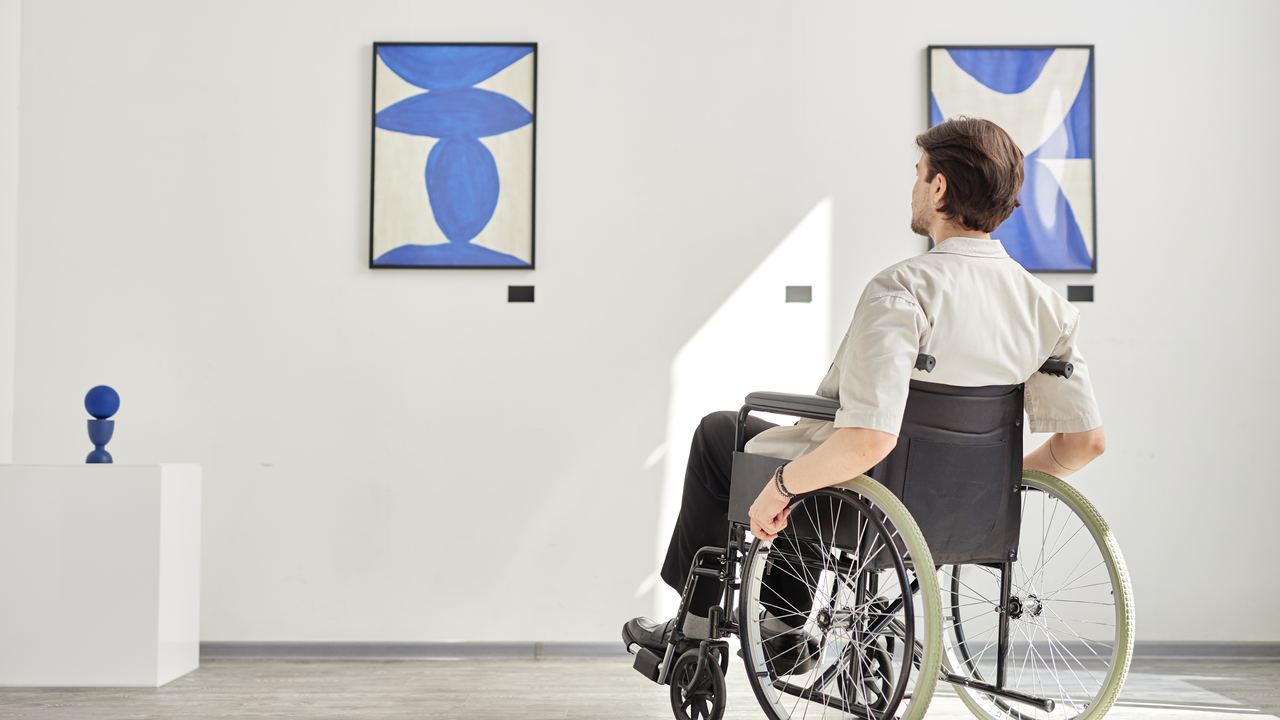
The Met Fifth Avenue is step-free if you use the right door. Skip the grand staircase at 82nd Street and go in at street level, either through the 81st Street door on Fifth Avenue or from the parking garage at 80th Street. Inside, the museum describes the building as accessible to wheelchair users and to anyone who needs to avoid stairs, and its interactive map shows the elevators and step-free routes. You can borrow a manual wheelchair at the 81st Street coat check. A visitor with a disability pays a reduced price, and a care partner goes in free. The Cloisters are harder: about 60 stairs between the main entrance and the admissions desk, and a free shuttle to a step-free door for anyone who can't take them.
Everything below comes from the museum's Fifth Avenue accessibility guide and its Cloisters accessibility guide (both last edited on July 28, 2026), and from the MTA's open data on which subway stations are accessible. For requests the museum's access office answers at 212-650-2010 (voice) and [email protected].
Where is the wheelchair-accessible entrance to the Met?
The museum gives two: Fifth Avenue at 81st Street, at street level just south of the main steps, and the parking garage at Fifth Avenue and 80th Street. Aim for the 81st Street door: the wheelchair loan desk (the coat check) is there, and so is Burke Hall, where stools are lent, at the start of the Uris Center for Education.
The garage is useful mainly if you are driving. It is open to the public only on weekday evenings (6 pm to midnight) and at weekends, parking there is not guaranteed, cars may be valet parked, and the clearance is 6 feet 6 inches, which can rule out a high-roof van. Check that figure against your vehicle before you rely on it (schedule and height as published in September 2026; see the museum's directions and parking page).
Security applies to everyone, and the museum warns that there may be lines to enter or to see an exhibition. Its guide adds a sentence worth remembering: "If you are unable to stand in line, please speak to a staff member."
Can you borrow a wheelchair at the Metropolitan Museum?
Yes. At Fifth Avenue the museum lends manual wheelchairs, standard and wide, from the coat check at the 81st Street entrance, first come, first served. If you will need help moving around, the museum asks you to come with a companion.
Is the loan free? The Cloisters guide says its wheelchairs are available "free of charge". The Fifth Avenue guide doesn't say either way, so ask at the coat check before assuming.
Your own equipment is welcome: manual and electric wheelchairs, mobility scooters, walkers, canes and crutches are allowed in all public areas. Some electronic personal assistance mobility devices (EPAMDs, the self-balancing kind) are allowed under museum guidelines, and for those you contact the access office in advance to get the rules and make a reservation.
If you can walk but can't stand for long in front of a painting, borrow a stool. Visitors with disabilities can pick one up in Burke Hall, inside the 81st Street entrance, or ask at the admissions desk. The museum also says there is seating throughout the galleries.
Are there elevators and step-free routes inside?
Yes. The museum's statement is short: "The Museum is accessible to wheelchair users and others who need to avoid stairs." The interactive map can show step-free routes between galleries, and staff will help you find elevators. Check the map on the day instead of memorizing a route. The Fifth Avenue building covers over two million square feet, and galleries close at short notice (the museum keeps a gallery closures list), so the step-free way between two rooms can change from one week to the next.
A practical rule for a long visit: choose two or three areas on the same floor and move between floors once. The first floor alone holds Egyptian art, arms and armor, the American Wing courtyard, Greek and Roman art and the Michael C. Rockefeller Wing. Our routes for two hours, half a day or a day can be trimmed this way.
How much do tickets cost for visitors with disabilities and care partners?
A visitor with a disability qualifies for a discounted ticket at the same price as the senior one, well below the full adult rate (current figures on our admission page). That ticket must be bought in person, at a ticketing desk, not online. A care partner who accompanies a visitor with a disability enters free. The Cloisters applies the same rule, and it calls the companion a caregiver.
If you live in New York State, pay-what-you-wish may cost less than the reduced rate; our admission page explains who qualifies. Every ticket is valid for the date printed on it at both Met locations. The museum doesn't publish a separate re-entry rule, so if you need a rest outside, keep your ticket and tell the staff at the door.
A care partner accompanying a visitor with a disability is eligible for complimentary admission.
What is available for visitors who are deaf or hard of hearing?
Hearing loops are installed at all ticketing and information desks in the Great Hall and in Burke Hall (Uris Center for Education). Assistive listening devices, with headsets or neck loops, are available for museum tours and programs: in the Grace Rainey Rogers Auditorium ask an usher, in the Uris Center classrooms ask staff. Exhibitions with audio have signs explaining the listening options.
Sign language interpreters can be requested for museum programs with at least two weeks' notice. Real-time captioning (CART) for live events also needs two weeks and depends on captioners being available. Virtual events and most online features carry closed captions. The museum lists upcoming events for D/deaf and hard-of-hearing visitors in its events calendar.
The audio guide has a text side: stops and transcripts are free on the museum's website, so you can read what others are listening to.
What is available for visitors who are blind or partially sighted?
Verbal imaging tours are free for visitors who are blind or partially sighted, arranged with advance notice through the access office. Verbal description at museum events needs two weeks' notice. Large-print label booklets exist for select exhibitions, at the exhibition entrance or through a QR code.
The free audio guide (on the website and in the Bloomberg Connects app) covers thousands of works, mostly in English. Dates for programs aimed at blind and partially sighted visitors are in the museum's events calendar.

Which access programs does the museum run today?
The museum's "Accessibility Programs and Resources" page (last edited in May 2026) lists seven named programs in four groups. We list them as the museum does; dates and booking are on the access events calendar. If you read about a program that is not on this list, ask the access office before planning around it.
| Program | For | What happens |
|---|---|---|
| Picture This! | Blind or partially sighted visitors | Works of art through detailed description, touch and other activities |
| Seeing Through Drawing | Blind or partially sighted visitors | Drawing workshops with verbal description and experiments with materials |
| Met Signs | D/deaf or hard-of-hearing visitors | Gallery conversations in ASL, without voice interpretation |
| Met Signs in the Studio | D/deaf or hard-of-hearing visitors | Gallery conversation in ASL, then art-making in a classroom |
| Met Escapes | People with dementia and their care partners | Discussion, art making and multisensory activities |
| Met Memory Cafe | People with dementia and their care partners | An afternoon of art, conversation and refreshments |
| Discoveries | Kids, teens and adults with intellectual or developmental disabilities, and autism | Tours and workshops |
Is there help for autistic visitors or anyone sensitive to crowds?
The museum links a sensory-friendly map for visitors on the autism spectrum. It is a PDF from 2015, so some rooms have changed since (it uses a wing name the museum dropped in 2021, and the Ancient Near East galleries it lists as quiet are closed today), but it sorts the building into quiet, crowded and loud spaces. The crowded ones it names are the Egyptian galleries, the Great Hall and the 19th-century European paintings on the second floor; the loud ones are the Great Hall and its balcony. The museum also runs the Discoveries program for visitors with intellectual or developmental disabilities and those on the autism spectrum. For children, the free 81st Street Studio says it is designed for people of all abilities and takes questions about accommodations on 212-570-3961.
On busy and quiet hours the museum publishes nothing, and this page won't guess. The timetable is all there is: it opens at 10 am, is closed on Wednesdays, and stays open until 9 pm on Fridays and Saturdays. Our hours page goes through the calendar.
Are service animals allowed at the Met?
Service animals are welcome at both locations. Pets and emotional support animals are not. Both accessibility guides draw that line in the same words.
On food, there is an exception that matters for some visitors: outside food and drink are prohibited except for visitors with food-related medical concerns. Water in a secure bottle is always allowed. Nothing is eaten in the galleries. The full list of what you can carry in is on our page about Met rules and what to bring.
The Met Cloisters, Fort Tryon Park
How accessible is the Met Cloisters?
Less than Fifth Avenue, and the museum says so: access is "somewhat limited" for wheelchair users and others who need step-free access, because the building is a landmark. There are cobblestones on the approach to the main (Postern) entrance, and inside, from the main entrance to the admissions desk, about 60 stairs.
The workaround is a free shuttle for visitors who need a step-free entrance; the pick-up stop is near the main entrance. By car you can be dropped at the step-free entrance in the courtyard (clearance 10 feet 6 inches high, 9 feet wide). Two parking spaces facing the museum are reserved for disabled permit holders, with more step-free parking in the courtyard. Inside, ask a security officer to use the elevator. A limited number of wheelchairs are lent free at the admissions desk in the Main Hall, where you can also borrow a stool.
Questions before the trip go to [email protected] or 212-731-1127 during opening hours.
Which subway stations near the Met are accessible?
The museum's directions tell most visitors to take the 4, 5 or 6 to 86th Street and walk three blocks west. For a wheelchair user that advice needs a correction. According to the MTA's own station data, 86 St on the Lexington Avenue line is only partially accessible: the note says "Uptown local only". Only the uptown local side is accessible, so the elevator helps on the way there on a northbound 6 train, but not on the way back downtown.
The station the museum does not mention is 86 St on the Q (Second Avenue line), which the MTA rates fully accessible. It is about a kilometer from the museum in a straight line, so plan a longer walk west or a bus ride along 86th Street. On the west side, neither 81 St-Museum of Natural History (B, C) nor 86 St on the 1 is rated accessible, so from there a crosstown bus across the park is the step-free option.
For the Cloisters, the museum is precise: for fully accessible public transit, take the A train to 181st Street, leave by elevator, and ride the M4 bus north seven stops to Margaret Corbin Drive/Cloisters. The more common route through 190 St is not rated accessible by the MTA, even though you leave that station by elevator. And do not confuse the A's 181 St with the 181 St station on the 1 train, a different station that is not accessible either.
At the Cloisters, step-free access starts with the right station: A train to 181 St, then the M4 bus seven stops north. Not 190 St, and not 181 St on the 1.
| Going to | Route | Step-free? | Watch out for |
|---|---|---|---|
| Fifth Avenue | Q to 86 St (Second Ave), then walk or bus west to Fifth Ave and 81st St | Yes, station fully accessible | About 1 km from the museum |
| Fifth Avenue | 4/5/6 to 86 St (Lexington Ave), walk three blocks west | Partly: MTA note "Uptown local only" | Check your platform and direction before you rely on it |
| Fifth Avenue | M1, M2, M3 or M4 bus: southbound on Fifth Ave (stops at 84th and 80th St) or northbound on Madison Ave (83rd St) | No station stairs; the museum uses the M4 in its fully accessible Cloisters route | The museum says "to 82nd Street", but there is no stop there; enter at 81st St, not the 82nd St steps |
| Fifth Avenue | Car to the garage at 80th St | Yes, step-free entrance from the garage | Public hours weekday evenings and weekends; 6 ft 6 in clearance |
| Fifth Avenue from the west side | B/C to 81 St or 1 to 86 St, then crosstown bus | No: those stations are not rated accessible | Take the crosstown bus the whole way instead |
| Cloisters | A to 181 St, elevator, M4 bus north 7 stops | Yes, the museum's accessible route | Weekend track work can affect the A |
| Cloisters | A to 190 St, walk 10 minutes through Fort Tryon Park | No: 190 St is not rated accessible | Then cobblestones and about 60 stairs |
| Cloisters | M4 bus from Madison Ave and 83rd St to the last stop | Bus route, about 1 h 25 min | Ask for the free shuttle to the step-free entrance |
| Cloisters | Car drop-off in the courtyard | Yes | Clearance 10 ft 6 in high, 9 ft wide |
Accessibility: quick answers
Is the Metropolitan Museum wheelchair accessible?
Yes, at Fifth Avenue. Enter at Fifth Avenue and 81st Street or through the garage at 80th Street, and use the museum's map for step-free routes and elevators.
Can I borrow a wheelchair at the Met?
Yes, manual chairs in standard and wide sizes, from the coat check at the 81st Street entrance, first come, first served. Bring a companion if you need someone to push.
Does a caregiver pay at the Met?
No. A care partner with a visitor with a disability is admitted free. The visitor's own reduced ticket is sold in person only.
Are there hearing loops?
Yes, at all ticketing and information desks in the Great Hall and Burke Hall. Assistive listening devices are available for tours and programs.
Can I bring my service dog?
Yes, service animals are welcome. Pets and emotional support animals are not.
Is the Met Cloisters accessible?
Partly. There are about 60 stairs from the main entrance to admissions, so ask for the free shuttle to the step-free entrance, or get dropped off in the courtyard.
Getting to the Metropolitan Museum
Every subway, bus and walking route to Fifth Avenue and the Cloisters, with the entrances that go with them.
Data verified on. From the Met's accessibility guides for both locations, its access programs page and MTA open data on station accessibility. Editorial Policy