



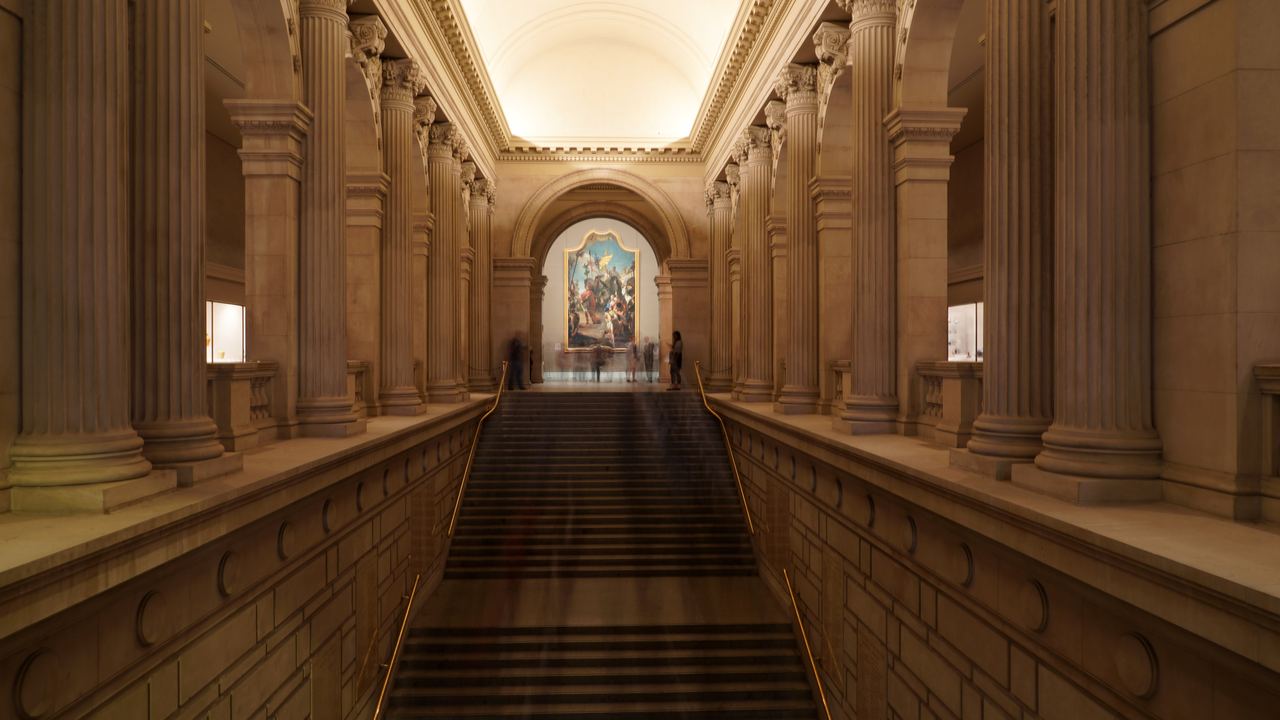
The Metropolitan Museum of Art was founded at a meeting on November 23, 1869, incorporated by New York State on April 13, 1870, and first opened to the public on February 20, 1872, in a rented building at 681 Fifth Avenue. It moved to its site in Central Park in 1880, got the Fifth Avenue facade most visitors know in 1902, opened the Cloisters in 1938 and was awarded the Temple of Dendur in 1967 (it arrived in New York in 1968). The next large change is the Tang Wing for modern and contemporary art: ground was broken on September 15, 2026, and the museum has announced its opening for 2030.
The dates below come from the museum's own records, from New York City's landmark designation reports or, where the museum published nothing, from the press, and we say which is which. Where two sources disagree, you'll see both. For the museum as it is organised today, see our guide to the institution.
The Met in twelve dates
From the founding meeting to the wing the museum has announced for 2030. Sources for each date are in the sections below.
The origins
1869–1870
Founded and incorporated
A meeting at the Union League Club founds the museum on November 23, 1869; the State Legislature incorporates it on April 13, 1870.
1872
First opening, 681 Fifth Avenue
The museum opens in the rented Dodworth Building on February 20, 1872, and moves to a mansion on West 14th Street in 1873.
1880
A building in Central Park
Calvert Vaux and Jacob Wrey Mould's Gothic Revival building opens on March 30, 1880, with President Rutherford B. Hayes presiding.
The growth
1902
Hunt's facade and Great Hall
The Fifth Avenue wing designed by Richard Morris Hunt and finished by his son opens on December 22, 1902.
1911–1926
McKim, Mead & White wings
Four wings, two north (1911, 1913) and two south (1916, 1926), complete the Fifth Avenue front.
1938
The Cloisters opens
The museum's branch for medieval European art opens in Fort Tryon Park on May 10, 1938.
1971
Admission fees and a master plan
Pay-what-you-wish admission begins with the City's approval, and the plan that adds six wings by 1991 is approved.
1978
The Temple of Dendur opens
Given by Egypt to the United States in 1965 and awarded to the Met in 1967, the temple opens to the public on September 27, 1978.
Today
2016–2020
Three sites: The Met Breuer
A third building on Madison Avenue opens on March 18, 2016; its last public day is March 12, 2020.
2020
Closure, then same-day tickets
Closed from March 13, the museum reopens Fifth Avenue on August 29, 2020; from September 12, with the Cloisters open again, a ticket covers both remaining sites on the same day.
2021
A name comes off the walls
On December 9, 2021 the Sackler name is removed from seven spaces, including the wing of the Temple of Dendur.
2030
Tang Wing and a new roof garden
Opening announced by the museum for Frida Escobedo's wing for modern and contemporary art, with an enlarged roof garden on the fourth floor.
How was the Metropolitan Museum founded?
The idea came before the museum. The Met's History page traces it to Paris in 1866, where a group of Americans agreed to create "a national institution and gallery of art", and to the lawyer John Jay, who brought the proposal home to the Union League Club in New York. The club's meeting of November 23, 1869, chaired by the poet William Cullen Bryant, founded the museum. Among the founders the city's Landmarks Preservation Commission lists the painter Frederic E. Church, the architect Richard Morris Hunt and Frederick Law Olmsted, one of the designers of Central Park. The State Legislature incorporated the museum on April 13, 1870.
It had a charter before it had a collection. Its first acquisition, on November 20, 1870, was a Roman marble sarcophagus carved with garlands, accession number 70.1. You can still see it in gallery 169 among the late Roman art (collection record, on view when we checked in September 2026). A purchase of 174 European paintings followed in 1871.
Did the Met first open on February 17 or February 20, 1872?
The first public opening was in the Dodworth Building at 681 Fifth Avenue, a rented space far downtown from today's museum. The museum's own archive article gives the date as February 20, 1872. The Landmarks Preservation Commission's 1977 report says February 17, and spells the building "Dodsworth". We follow the museum, whose date comes from its archives, and mention the other so that nobody mistakes the difference for a typo on either side.
In 1873 the collection moved to larger rooms in the Douglas Mansion at 128 West 14th Street, under a lease signed on March 1 of that year. It stayed there until 1879, when the new building in the park was nearly ready.
When did the Met move to Central Park, and is the 1880 building still there?
The site in the park was chosen in 1872, largely at the urging of Andrew Haswell Green of the Central Park Commission, himself one of the founders. Ground was broken in 1874 and construction started in 1877. The architects were Calvert Vaux and Jacob Wrey Mould, who had designed the park's bridges, and they produced a brick Gothic Revival building that the museum calls "Ruskinian Gothic". It opened on March 30, 1880, with President Rutherford B. Hayes presiding.
The trustees could not pay for it, so the City did, and kept ownership of the building while the trustees kept the collections. The Landmarks report notes that this "became the pattern which was followed by most of the major art museums in America". What the arrangement means today is explained in our guide to the institution.
The 1880 building was never torn down. Every later addition was built around it, and parts of it can be seen from inside. Its west facade survives inside the Robert Lehman Wing, and a museum article notes that the ceiling of today's Medieval Sculpture Hall (gallery 305) keeps beams and cornices from that first structure. Some tours get one wall wrong. The classical stone front you see across the Petrie European Sculpture Court was designed by Theodore Weston, not by Vaux and Mould: it is the south facade of his wing of 1884 to 1888, the museum's first extension. Weston added a north wing, with Arthur L. Tuckerman, between 1889 and 1894, and the City paid for both.

Who designed the Fifth Avenue facade, and why are there four uncarved blocks on top?
On April 16, 1895 the State Legislature authorized the City to spend a million dollars on a new building. Richard Morris Hunt, a founder and the chairman of the museum's building committee, designed the Beaux-Arts wing that now faces Fifth Avenue, with the Great Hall behind it, and drew a master plan for the whole site. Hunt died on July 31, 1895. His son, Richard Howland Hunt, carried out the design, with George B. Post as consulting architect. The wing was finished some time before the public saw it: it did not open until December 22, 1902, "because display cases had to be built", the Landmarks report says. Hunt senior also designed the pedestal of the Statue of Liberty.
Look up at the paired columns of the entrance. Above them sit four massive blocks of rough stone. In a 2006 press release on the restored facade, the museum explained that Hunt meant them to be carved by four sculptors into groups representing "the four great periods of Art": Egyptian, Greek, the Renaissance and modern art. Nobody ever carved them, and they were left in place: the museum judged their mass "necessary to balance the façade". The facade has a second unfinished feature: four niches with pedestals that stayed empty until 2019, when the museum began an annual Facade Commission for contemporary sculptors.
Who built the rest of the Fifth Avenue front?
The long wings either side of Hunt's centre are by McKim, Mead & White. The city's 1967 designation report for the exterior lists two units to the north, completed in 1911 and 1913, and two to the south, completed in 1916 and 1926. The original American Wing opened in 1924, and its south front was the marble facade of the Branch Bank of the United States, taken down on Wall Street and rebuilt here. That front now stands indoors, across the glass-roofed Charles Engelhard Court (gallery 700).
When did the Met Cloisters open?
The Cloisters grew out of another man's museum. The sculptor and dealer George Grey Barnard opened his own Cloisters on Fort Washington Avenue in 1914, and John D. Rockefeller Jr. paid for the Met to buy it, with most of its contents, in 1925. Rockefeller then gave the City the land that became Fort Tryon Park, about four acres of which were set aside for a new building by the architect Charles Collens. In 1933 he also donated some 700 acres of the New Jersey Palisades across the Hudson to protect the view. The new Cloisters opened on May 10, 1938.
Its largest single piece came twenty years later. The twelfth-century apse from the church of San Martín at Fuentidueña, in Spain, arrived in 1958 and took until 1961 to rebuild. Spain lent it in 1957, and it remains a long-term loan. Visiting details are in our Cloisters guide.
How did the Temple of Dendur end up in New York?
Egypt's thank-you went to the United States, and the Met only won it afterwards. When the Aswan High Dam was about to flood Lower Nubia, UNESCO's International Campaign to Save the Monuments of Nubia moved twenty-two temples to safe ground, and in 1965 Egypt gave the temple and its gateway to the United States to recognize its "substantial contribution" to that campaign. A commission appointed by the National Foundation on the Arts and the Humanities then reviewed bids from institutions that wanted it, and on April 28, 1967 President Lyndon B. Johnson signed the letter that awarded it to the Met.
The stones crossed the Atlantic in crates, which were delivered on August 20, 1968 to an air structure on what was then the museum's south parking lot, where the Petrie Court stands today. Kevin Roche John Dinkeloo and Associates designed a glass-walled wing for it, with the temple facing east under a wall of windows, and it opened to the public on September 27, 1978, according to the museum's essay A Monumental Gift to The Met. Tours built around it and the Egyptian galleries are listed under Egyptian art and the Temple of Dendur.
The wing carried the Sackler family name until December 9, 2021, when the museum and the families announced that seven spaces, "including the wing that houses the iconic Temple of Dendur", would no longer bear it. No new name has replaced it.
What did the 1971–1991 master plan add?
The museum's present footprint is largely the work of one plan. The master plan by Kevin Roche John Dinkeloo and Associates was approved in 1971 and completed in 1991, and it wrapped the old building in six additions: the Robert Lehman Wing (1975), the wing for the Temple of Dendur (1978), the new American Wing (1980), the Michael C. Rockefeller Wing for the arts of Africa, Oceania and the Americas (1982), the Lila Acheson Wallace Wing for modern and contemporary art (1987) and the Henry R. Kravis Wing for European sculpture and decorative arts (1991).
Since then the museum has mostly rebuilt inside its walls. The Greek and Roman galleries reopened in 2007 after fifteen years of work, the Islamic art galleries on November 1, 2011, and the American Wing's painting galleries on January 16, 2012. The Rockefeller Wing reopened on May 31, 2025 and drew 33,700 visitors that day, the museum's busiest single day since 2017 (FY2025 release). Before 2020, the museum noted, it "had not been closed for more than three days in over a century".
What were the Met Breuer years?
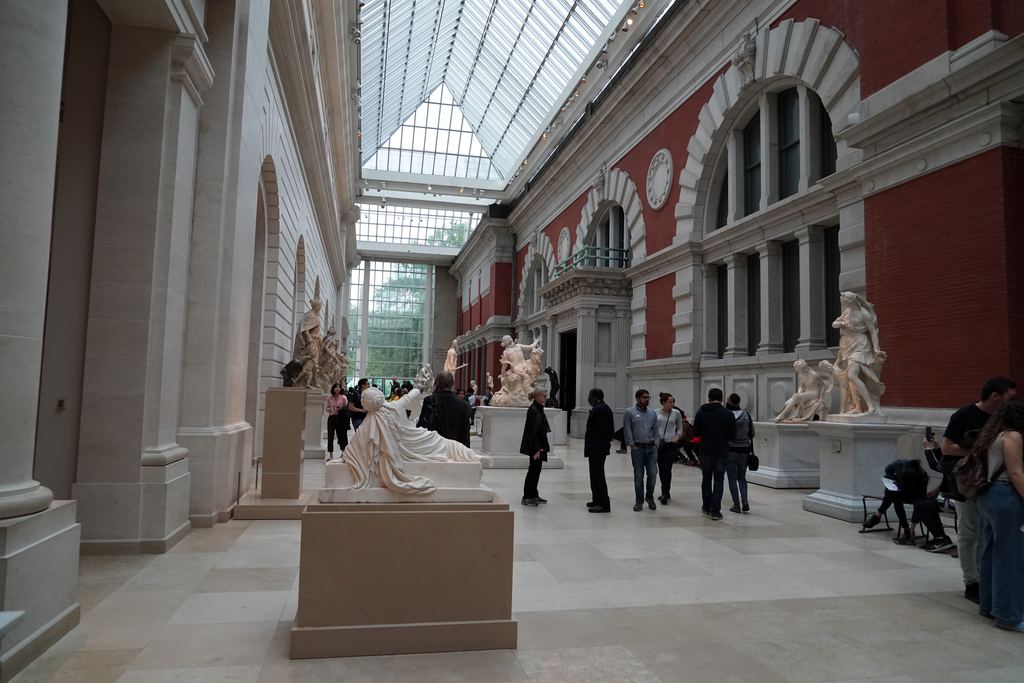
From 2016 to 2020 the museum had three addresses. It leased the Marcel Breuer building at 945 Madison Avenue, designed for the Whitney Museum of American Art, and opened it as The Met Breuer on March 18, 2016 for modern and contemporary exhibitions. In September 2018 the Met and the Frick Collection announced that the Frick would move into the building while its own house was renovated. The pandemic cut the Met's run short. The Breuer's last public day was March 12, 2020, and the museum's annual report for that year says it "did not reopen to the public, and the building was transferred to the Frick Collection in August 2020." Keep those four years in mind when reading attendance: from fiscal 2016 to fiscal 2020 the totals include a third building.
Was the Met ever free? Admission since 1870
For most of its first century, entry was free on most days. City money ran the building, and when it stopped being enough the Parks Department authorized the museum to charge visitors, as the 2013 lease amendment records. What followed was 47 years of pay-what-you-wish for everyone, and then a split between New York State residents and everyone else. The recommended amount on the signs never bound anyone, which is why lawsuits in 2012 and 2013 argued the museum should be free and why the 2016 settlement changed one word on the signs. The steps, with a source for each:
| When | What changed | Source |
|---|---|---|
| Until 1971 | No general admission fee: City money covered running the building until, in the lease amendment's words, it was "no longer sufficient" | Met press release, Oct 24, 2013 |
| 1971 | Discretionary admission agreed with the City: visitors pay what they wish, with a recommended amount posted | Met press release, Oct 24, 2013 |
| July 1, 2011 | Recommended adult amount rises from $20 to $25 (seniors $17, students $12) | NBC New York, June 4, 2011 (press) |
| Oct 24, 2013 | Lease amendment confirms the policy; future changes still need City approval | Met press release |
| 2015 | Courts dismiss claims that the museum must be free; the dismissal is affirmed on appeal | Met press release, Feb 26, 2016 |
| Feb 26, 2016 | Class action settled: signs change from "recommended" to "suggested" admission | Met press release |
| March 1, 2018 | $25 becomes mandatory for visitors from outside New York State; state residents and NY, NJ and CT students keep pay-what-you-wish | Met press release, Jan 4, 2018 |
| July 1, 2022 | Full price rises to $30 (seniors $22, students $17) | The Art Newspaper, June 29, 2022 (press) |
| September 2026 | The prices set on July 1, 2022 still apply; eligible New Yorkers and students pay what they wish, one cent minimum | Met Plan Your Visit page |
The two press-sourced rows are solid (NBC New York in 2011, The Art Newspaper in 2022), but we could not find a release of the museum's own for either. For what you pay today and who qualifies for pay-what-you-wish, see our admission guide.
How long is a Met ticket valid, and was it ever three days?
Same day. That was the rule for decades, and it is the rule again as of September 2026: a ticket covers both buildings and all exhibitions on the date printed on it. In between, the rule changed four times, which is why old forum answers contradict each other.
| From | Validity | Buildings covered | Source |
|---|---|---|---|
| Decades, to April 30, 2013 | Same day | Main building and the Cloisters | Met release, 2013 |
| May 1, 2013 | One extra Cloisters admission within seven days, one way only: main building first | Main building, then the Cloisters | Met release, 2013 |
| March 2016 | Same day | Fifth Avenue, Cloisters and Breuer | Met release, Feb 26, 2016 |
| March 1, 2018 | Three consecutive days, full-price tickets only | All three | Met release, Jan 4, 2018 |
| Sept 12, 2020 | Same day, exhibitions included | Fifth Avenue and Cloisters | Met release, Aug 25, 2020; unchanged Sept 2026 |
A "three-day Met ticket" is the rule of March 2018 to March 2020. It lapsed with the 2020 closure, and its end never got a release of its own: the return to same-day entry is one sentence in the museum's announcement about timed tickets of August 25, 2020, effective from September 12.
The 2013 rule is the one most often misremembered. It only worked one way: a ticket from the main building got you into the Cloisters during the following week, not the reverse. Three years later the settlement release of February 26, 2016 set the next step: from March, when the Met Breuer opened, one admission covered all three buildings on the same day.
How many people visit the Met each year?
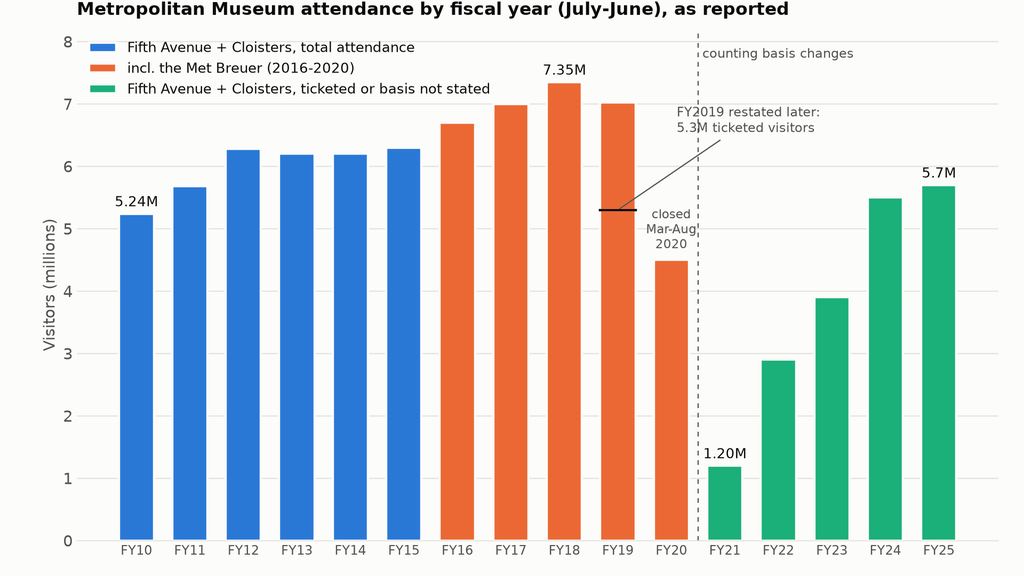
The Met reports attendance by fiscal year, July 1 to June 30. As published, the figure rose from 5.24 million in FY2010 to a record 7.35 million in FY2018, across three buildings. For FY2025 the museum reported over 5.7 million visitors at its two sites. Read quickly, that is a fall of more than a fifth. The series doesn't support that reading, and there are three reasons why.
The count changed. In 2019 the museum announced 7,027,858 visitors for FY2019. Its annual report for fiscal 2023 (July 2022 to June 2023) restates the same year as "over 5.3 million ticketed visitors (at The Met Fifth Avenue and The Met Cloisters)". Taking out the Breuer's 326,392 visitors explains about a third of a million of the 1.7 million gap. The rest has to come from counting only ticketed visitors, which presumably leaves out members and other entries without a ticket. The museum hasn't explained the difference.
COVID-19. The museum closed on March 13, 2020 and reopened on August 29 with timed tickets and reduced capacity. FY2020 ended at about 4.5 million, FY2021 at about 1.2 million. FY2022 (2.9 million) and FY2023 (3.9 million) are both labelled "ticketed".
The basis may have changed again. FY2024's "more than 5.5 million visitors" carries no "ticketed" label. It is 41 percent above FY2023, while admissions revenue rose 8.5 percent in the same year, according to the FY2024 annual report. That gap points to a broader count, but we could not confirm it, so we don't treat FY2023 and FY2024 as the same measure.
Compare FY2022 with FY2023, or FY2024 with FY2025. Don't set FY2018's 7.35 million against FY2025's 5.7 million: the first counts three buildings on the old basis, the second two buildings on a basis the museum hasn't defined.
| Fiscal year | Visitors as published | Buildings | What was counted |
|---|---|---|---|
| FY2010 | 5.24 million | Fifth Ave, Cloisters | Total |
| FY2011 | 5.68 million | Fifth Ave, Cloisters | Total |
| FY2012 | 6.28 million | Fifth Ave, Cloisters | Total |
| FY2013 | 6.2 million | Fifth Ave, Cloisters | Total |
| FY2014 | 6.2 million | Fifth Ave, Cloisters | Total |
| FY2015 | 6.3 million | Fifth Ave, Cloisters | Total |
| FY2016 | 6.7 million | Fifth Ave, Cloisters, Breuer (from March) | Total |
| FY2017 | 7 million | Three buildings | Total |
| FY2018 | More than 7.35 million (record) | Three buildings | Total |
| FY2019 | 7,027,858 | Three buildings | Total; later restated |
| FY2020 | About 4.5 million | Three buildings | Closed from March 13 |
| FY2021 | About 1.2 million | Fifth Ave, Cloisters | Reopened Aug 29 with timed entry |
| FY2022 | 2.9 million | Fifth Ave, Cloisters | Ticketed visitors |
| FY2023 | 3.9 million | Fifth Ave, Cloisters | Ticketed visitors |
| FY2024 | More than 5.5 million | Fifth Ave, Cloisters | Not stated |
| FY2025 | Over 5.7 million | Fifth Ave, Cloisters | Not stated |
One more trap: the museum also published a calendar-year total, 7.36 million for 2018. It is not a fiscal year and doesn't belong in the same series. Figures from statistics aggregators often mix the two, or use bases nobody states.
What is changing at the Met before 2030?
Two closures shape the next few years. The Iris and B. Gerald Cantor Roof Garden closed after its last annual commission ended on October 19, 2025. The museum's announcement says the series will resume after the "anticipated 2030 reopening" with "an expanded Cantor Roof Garden on the fourth floor". The modern and contemporary galleries closed for the same construction and, by the same announcement, are due back in 2030; a few of their works hang in other departments' galleries meanwhile (see our departments map). The museum's gallery closures page has the current state of both.
The building going up is the Oscar L. Tang and H.M. Agnes Hsu-Tang Wing. The museum named Frida Escobedo as architect on March 14, 2022, the first woman to design a wing of the Met. It showed the design on December 10, 2024 and broke ground on September 15, 2026. The groundbreaking release gives 69,500 square feet of exhibition space, "a nearly 50 percent increase" on the current modern wing, plus about 18,500 square feet of terraces on the fourth and fifth floors.
One number needs care. The $550 million often quoted as the wing's price is a fundraising milestone in private donations that the museum announced in May 2024. At the groundbreaking it said it had raised $670 million, enough for "the full cost of construction" and part of a new endowment for running the wing. The construction cost itself has not been published.
Also announced and not yet done: on May 14, 2026 the museum and the Neue Galerie New York announced plans to merge in 2028. Until then the Neue Galerie is a separate museum with its own tickets.
Questions about the Met's history
When was the Metropolitan Museum of Art founded?
At a meeting at the Union League Club on November 23, 1869. New York State incorporated it on April 13, 1870, and it first opened to the public on February 20, 1872 (the city's 1977 landmark report says February 17).
Has the Met always been in Central Park?
No. It opened at 681 Fifth Avenue in 1872, moved to 128 West 14th Street in 1873, and has been on its Central Park site since March 30, 1880.
When did the Met start charging admission?
In 1971, as pay-what-you-wish with a recommended amount. A fixed price became mandatory for visitors from outside New York State on March 1, 2018. Today's prices: admission guide.
Why don't people say "Sackler Wing" any more?
Because the name was removed on December 9, 2021 from seven spaces, including the wing of the Temple of Dendur. No replacement name was given, and older guides and films still use it. More name changes and myths: myths and curiosities.
When will the Met roof garden reopen?
The museum has announced 2030, with the opening of the Tang Wing, and an enlarged Cantor Roof Garden on the fourth floor. It has been closed since the 2025 commission ended on October 19, 2025.
Did the Met really have over 7 million visitors a year?
As published, yes: 7 million in FY2017, more than 7.35 million in FY2018 and 7,027,858 in FY2019, across three buildings. The museum later restated FY2019 as over 5.3 million ticketed visitors at its two remaining sites.
Keep reading
Myths and curiosities
The uncarved blocks were only the start: films, the Mona Lisa's 1963 visit, the hippo called William.
The Met Cloisters
The 1938 museum in Fort Tryon Park: how to get there, hours, and what to see first.
Departments and collections
Where each of the 17 departments sits today, floor by floor, with works checked on view.
Data verified on. Dates from Met releases, annual reports, its History page and NYC landmark reports; two admission rows from press. Read 29 Sept 2026. Editorial Policy